“Know how to solve every problem that has been solved.”“What I cannot create, I do not understand.”— Richard Feynman
Jamming: Where a Packing First Becomes Rigid
Statistical Mechanics
⛓
What you need to know first
4 concepts, 2 layers
The requisite-knowledge inventory for this page, bottom-up: the
primitives at the base, combined upward until you reach what this page
assumes. Skim the layers you already own; start wherever the ground gets unfamiliar.
1 of these are concepts without a dedicated page yet —
the grey chips. Following the linked ones first makes the rest land.
Pour sand into a jar and shake it: at some density the grains lock and the
pile holds a shovel. Nothing melted or froze — the grains just ran out of
room to move, and a fluid of nothing became a solid that supports load.
That is jamming, and its cleanest laboratory is the
simplest one imaginable: soft disks that pay an energy penalty only when
they overlap. Compress a random arrangement of them and there is a sharp
packing fraction φJ where the system first cannot avoid
overlaps — where the nearest energy minimum stops being zero. This page runs
the O'Hern–Silbert–Liu–Nagel protocol (2003) to pin that point, confirms
the rigidity condition that makes it a genuine transition, and measures how
stiffness grows above it — where the model teaches a lesson about
finite-size systematic error that the raw exponent alone would hide.
@njitdef energy_forces(pos, radii, L): """Harmonic soft disks: V = (1/2)(1 - r/sigma)^2 for r < sigma, else 0.""" F = np.zeros((N, 2)); E = 0.0; contacts = np.zeros(N) for i in range(N-1): for j in range(i+1, N): d = min_image(pos[i] - pos[j], L) # periodic box r = norm(d); sij = radii[i] + radii[j] if r < sij: # only overlaps cost energy overlap = 1 - r/sij E += 0.5 * overlap**2 fpair = overlap / (sij * r) * d F[i] += fpair; F[j] -= fpair contacts[i] += 1; contacts[j] += 1 return E, F, contacts@njitdef fire_minimize(pos, radii, L): """FIRE: run MD, but whenever the velocity points against the force, kill it — descend to the nearest energy minimum without solving a Hessian.""" v = zeros_like(pos); dt = 0.02; alpha = 0.1 E, F, _ = energy_forces(pos, radii, L) while max_force(F) > 1e-11: if dot(F, v) > 0: # going downhill: accelerate v = (1-alpha)*v + alpha*norm(v)/norm(F)*F dt = min(dt*1.1, dt_max); alpha *= 0.99 else: # fighting the force: freeze v[:] = 0; dt *= 0.5; alpha = 0.1 v, pos = velocity_verlet(pos, v, F, dt) # unit-mass Verlet step E, F, _ = energy_forces(pos, radii, L) return E / N
The onset of rigidity is an energy minimum turning on
The order parameter for jamming is not a density or a magnetization — it is
whether the potential energy of the relaxed packing is zero. Below
φJ a random configuration can always be squeezed into a
nearby arrangement with no overlaps at all: energy zero, no restoring
forces, a floppy assembly of disks that happen to be near each other. Above
φJ there is not enough room; every minimum has some
residual overlap, some stored elastic energy, and a network of contacts that
pushes back. So the protocol is: take a random (infinite-temperature)
configuration, drop it straight down to its nearest energy minimum, and ask
whether that minimum is zero. FIRE does the dropping — it
runs molecular dynamics but kills the velocity the instant it starts
fighting the force, so it slides downhill to a local minimum without ever
building or inverting a Hessian. Bisect the packing fraction between a floppy
sample and a rigid one and you converge on that sample's threshold.
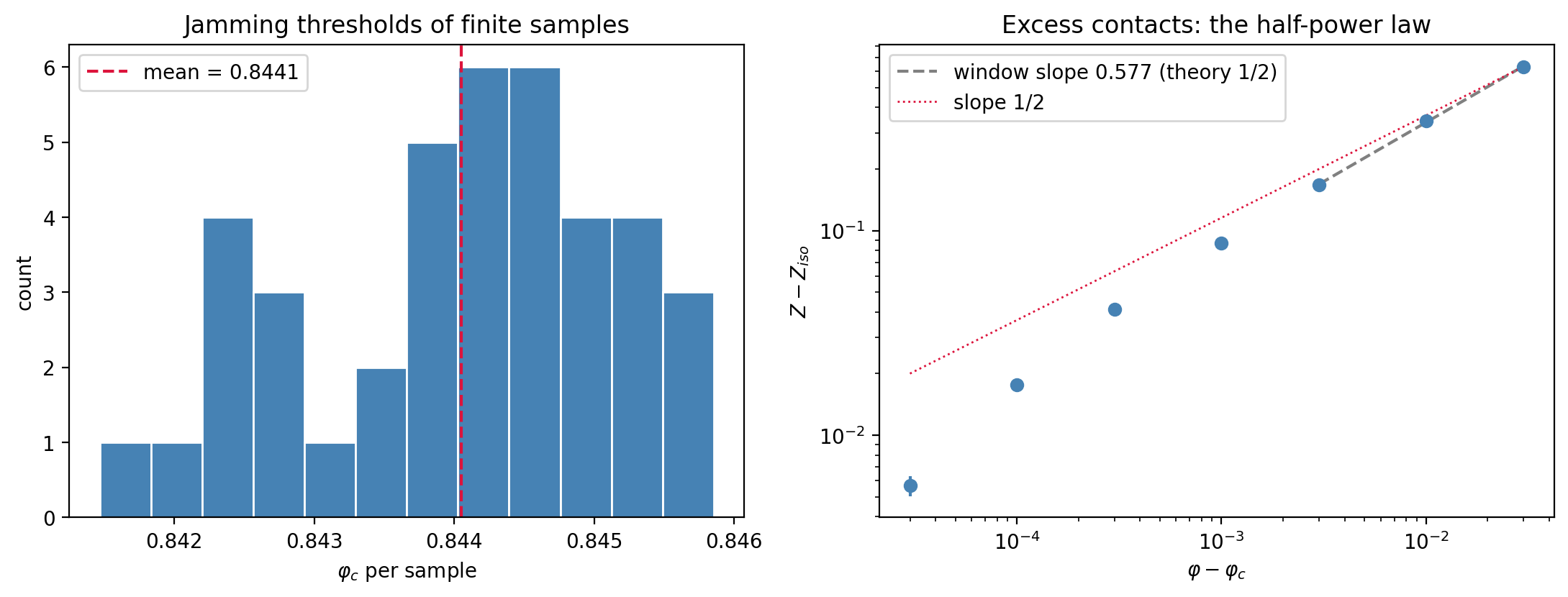
N = 512 bidisperse disks (ratio 1.4), 40 samplesphi_J = 0.8441 +/- 0.0002 (O'Hern 2D bidisperse ~ 0.84; 40 samples)dphi = 3e-05: Z = 4.0057 +/- 0.0006 Z - 4 = 0.0057 e/N = 1.98e-10dphi = 1e-04: Z = 4.0177 +/- 0.0012 Z - 4 = 0.0177 e/N = 2.14e-09dphi = 3e-04: Z = 4.0411 +/- 0.0015 Z - 4 = 0.0411 e/N = 1.91e-08dphi = 1e-03: Z = 4.0870 +/- 0.0016 Z - 4 = 0.0870 e/N = 2.13e-07dphi = 3e-03: Z = 4.1676 +/- 0.0024 Z - 4 = 0.1676 e/N = 1.96e-06dphi = 1e-02: Z = 4.3429 +/- 0.0028 Z - 4 = 0.3429 e/N = 2.27e-05dphi = 3e-02: Z = 4.6330 +/- 0.0033 Z - 4 = 0.6330 e/N = 2.16e-04fit (all offsets): exponent 0.667fit (dphi >= 3e-3 window): exponent 0.577 (O'Hern exponent: 0.5)local log-slopes (near -> far from jamming): 3e-05 -> 1e-04: 0.946 1e-04 -> 3e-04: 0.767 3e-04 -> 1e-03: 0.622 1e-03 -> 3e-03: 0.597 3e-03 -> 1e-02: 0.595 1e-02 -> 3e-02: 0.558
Over 40 independent samples the threshold lands at
φJ=0.8441±0.0002 — squarely on the accepted
value near 0.84 for 50:50 bidisperse disks at size ratio 1.4 (the ratio is
there to frustrate crystallization; equal disks would rather form a
triangular lattice than jam). The spread across samples is real physics, not
noise: a finite random packing has no single jamming point, it has a
distribution of them that narrows as N→∞. The energy
per particle in the last column vanishing as the offset shrinks —
2×10⁻¹⁰ at the closest approach — is the check that we
are sitting just barely inside the jammed phase at each measurement, not
deep in it.
Isostaticity: exactly enough contacts, and not one more
Why is jamming sharp? Because of a counting argument that goes back
to Maxwell. A packing of N disks in d dimensions has
dN positional degrees of freedom to pin down. Each contact
between two disks is one constraint (their separation is fixed at touching).
Rigidity needs at least as many constraints as freedoms; stability against
collapse forbids many more than that. At the jamming point the two bounds
meet — the packing is isostatic, carrying exactly enough contacts
to be rigid and no redundant ones:
Ziso=2d=4(in d=2).
The factor of two is because each contact is shared by two disks. The
measurement confirms it cleanly: extrapolated to the threshold the contact
number Z runs straight to 4 (it reads 4.006 at the closest
offset and falls toward 4 as the offset shrinks). One subtlety makes or
breaks the number — rattlers. A packing always traps a few disks
with fewer than d+1=3 contacts: caged loosely but not actually
load-bearing, free to rattle in their holes. They carry no force and must be
removed before counting, iteratively, because removing one can strand
another. Count them in and Z comes out below 4 and the whole
isostatic story dissolves. The rigidity is in the backbone, and finding the
backbone is half the measurement.
Stiffness above jamming — and where the exponent hides
Push past φJ and the packing stiffens: it grows extra
contacts beyond the isostatic minimum, and the excess is the signature power
law of the jamming transition,
Z−Ziso∼(φ−φJ)1/2.
A square root — the excess coordination grows infinitely steeply at
the transition, the fingerprint that made jamming look like a critical
point. Now the part worth the page. Fit all seven offsets and the exponent
comes out 0.667, not 0.5 — off by a third. The temptation
is to fix it by measuring closer to φJ, where the
asymptotic law "should" be cleanest. That is exactly backwards, and the
local slopes say so: reading them near-to-far from jamming they run
0.95, 0.77, 0.62, 0.60, 0.60, 0.56 — steepest closest in, drifting
toward 0.5 as you back away. The closest offset of all, at
3×10⁻⁵, has a local slope of 0.95 — nearly double the
true exponent. The smallest offsets are the most contaminated, not the least.
The reason is finite size. In a box of N=512, the jamming
transition is rounded: below a crossover
Δφ∗∼1/N the excess coordination hits a
floor set by the handful of surface contacts, and the clean power law is
buried under that floor. The asymptotic 1/2 law lives at
intermediate offsets — far enough out that finite-N
rounding is negligible, not so far that the packing has left the critical
regime. Fit only the window Δφ≥3×10⁻³
and the exponent drops to 0.577, with the local slope at
the largest offsets down to 0.56 and still falling toward the true value the
thermodynamic limit would deliver. The dotted 1/2 reference on
the plot runs right through the far data and pulls away from the near data —
a picture of the rounding. The lesson generalizes past jamming: when a
finite system rounds a transition, the asymptotic exponent is not at the
point, it is in the window you can see before finite size takes over —
and a fit that swallows the rounded region reports a number that is an
artifact of the box, precise and wrong.
Try First
Each prompt asks a checkable question about the working code or math
above — predict an output, derive a sign, state an invariant, find a
bug. Commit to an answer before clicking "reveal." That commitment is
the whole point: if your answer matched, you understand the piece you
were looking at; if it didn't, that's the part worth re-reading.
predict
To measure the jamming exponent more accurately, would you (a) measure at
smaller Δφ, closer to φJ, or
(b) simulate a larger system N?
answer
(b), and it is the whole point of the page. Measuring closer to
φJ at fixed N walks you into the
finite-size rounded region, where the local slope steepens away from
1/2 (0.95 at the closest offset here) — the opposite of cleaner. The
rounding sets in below Δφ∗∼1/N, so
the only way to push the clean power-law window to smaller offsets is to
raise N, shrinking Δφ∗.
Production jamming studies run thousands to tens of thousands of disks
and extrapolate N→∞ for exactly this reason.
With a fixed box, the right move is not "get closer" but "fit the window
finite size lets you see."
why does this work
Why must rattlers be removed iteratively rather than in a single
pass over the packing?
answer
Because a rattler is defined by its contacts with load-bearing
disks, and removing one rattler can turn another disk into a rattler.
Disk A might have three contacts — enough to look pinned — but if one of
those three is a rattler B, then once B is stripped out A has only two
real contacts and is itself a rattler, which might in turn free C.
Rigidity is a global backbone property, not a local one, so you strip
every disk with fewer than d+1=3 contacts, recount, and
repeat until the set stops changing. It is the same fixed-point idea as
connectivity pruning — peel the
leaves, then peel the newly exposed leaves. Skip the iteration and you
overcount the backbone and misread Ziso.
what if
FIRE zeroes the velocity whenever F⋅v<0.
Plain gradient descent never overshoots like that. Why is throwing away
momentum an improvement over just following the gradient downhill?
answer
Because the energy landscape near jamming is a long, narrow, curved
valley — ill-conditioned, with a stiff direction across the valley and a
soft direction along it. Pure gradient descent crawls along the soft
direction at a rate set by the stiff one; it is agonizingly slow exactly
where jamming lives. FIRE keeps the momentum that carries it
fast along the valley floor (the accelerating branch), and only discards
it when that momentum would climb the far wall (the
F⋅v<0 branch) — an adaptive
heavy-ball method that gets the acceleration of momentum without the
overshoot. It reaches the same minimum as descent, orders of magnitude
faster, without ever forming the Hessian a Newton method would need. The
connection to momentum methods
in optimization is exact — FIRE is momentum with a restart rule.
Extensions
Finite-size scaling done right — run N from 256 to 8192, collapse Z−Ziso against N(φ−φJ), and read the exponent from the data collapse rather than a single-N fit — the same machinery as the Ising finite-size scaling flagship.
The soft modes — an isostatic packing sits at the edge of stability, so its vibrational spectrum has an anomalous excess of low-frequency modes (the "boson peak"): diagonalize the dynamical matrix and watch the density of states pile up at ω→0 as φ→φJ.
Pressure and bulk modulus — both vanish as power laws above φJ too; the contact-value machinery from the hard-sphere fluid connects the overlaps here to the pressure there.
From jamming to glass — jamming is the T=0 endpoint; turn temperature back on and the same disks fall out of equilibrium into a glass. The hard-sphere fluid compressed fast enough never reaches its crystal and jams instead — the granular and the glassy are two faces of the same rigidity.
Reproduce it
scripts/gen_jamming.py runs the full protocol —
numba-compiled FIRE, per-sample bisection, iterative rattler removal — in a
couple of minutes. Its history is the page's own lesson: an earlier version
reported the exponent as high as 0.75 by fitting all offsets and chasing
the number with tighter bisection tolerances, treating a finite-size
artifact as a convergence problem. The fix was not a better solver but a
better window — the realization that the box, not the algorithm,
sets how close to φJ the asymptotic law is still visible.