“Know how to solve every problem that has been solved.”“What I cannot create, I do not understand.”— Richard Feynman
SymGPT: Training a Transformer to Do Symbolic Regression
Machine Learning
The genetic-programming and
SISSO engines both start every problem
from nothing — a fresh evolutionary search, a fresh feature-space sweep — for
each new table of numbers. A transformer changes the economics. Train it once
on millions of synthetic (data, formula) pairs, and it learns the prior
that maps a cloud of points to the equation most likely to have produced them;
a brand-new problem is then answered in a single forward pass. This is symbolic
regression as translation — points in, formula out — and it is the idea behind
the recent "neural symbolic regression that scales" line of work. This page
builds a small one from scratch: a two-million-parameter decoder trained on a
stream of random expressions, which then recovers formulas it has never seen,
including ones it has to algebraically simplify to get right.
Trees as sequences, formulas as language
To let a language model emit a formula, write the formula as a sentence. Every
expression is a tree, and a tree has a unique prefix (Polish)
serialization — a preorder walk that is parenthesis-free and reconstructs the
tree exactly. sin(Cx) becomes the token stream
sin mul C x; (e−x)2 becomes
sq exp neg x. The vocabulary is tiny — a dozen operators plus the
variable and a single placeholder — so the model is doing next-token prediction
over a fourteen-word language whose sentences are equations.
# A formula is a tree; serialize it in PREFIX (Polish) order -> a token sequence,# parenthesis-free and bijective with the tree, exactly what a decoder emits.# vocab (14): <pad> <bos> <eos> add sub mul div neg sq sin cos exp x C# f(x) = sin(C * x) -> prefix: sin mul C x# f(x) = (exp(-x))^2 -> prefix: sq exp neg x# f(x) = x + cos(x) -> prefix: add x cos x# Every constant collapses to ONE placeholder token 'C'. The network predicts the# SKELETON (the structure); the actual numbers are fit afterward. So training data is# infinite and free: sample a random tree, evaluate it at 30 points, emit (points, prefix).
The one move that makes this tractable: every numerical constant collapses to a
single placeholder token C. The network never has to spell out
3.14159 digit by digit — it predicts the skeleton, the
bare structure of the formula, and the real constants are fit numerically
afterward. That decouples the hard combinatorial problem (what is the shape?)
from the easy continuous one (what are the numbers?), and it means the training
data is effectively infinite: sample a random tree, draw random constants,
evaluate it at thirty points, and emit the (points, skeleton) pair. No labels
to collect, no dataset to curate — the supervision is generated on the fly.
The model: read the points, write the formula
The architecture is a plain decoder-only transformer with one twist for the
input. The thirty (xi,yi) points are a set, not a
sequence — their order carries no information — so each point is embedded by a
small MLP and fed as context with no positional encoding, leaving the
model permutation-invariant over the samples. The expression tokens that follow
do get positional encodings and a causal mask, so generation is autoregressive:
each token attends to all of the point-context and to the tokens already
written, and predicts the next one.
class SymGPT(nn.Module):        # a small decoder-only transformer (2.27M params)
    def forward(self, points, tokens):
        # each (x_i, y_i) -> MLP -> d_model, used as PERMUTATION-INVARIANT context
        # (no positional encoding on the point set -- order of the samples is meaningless)
        pe = self.point_mlp(points) + self.type_emb[POINT]        # (B, n_points, d)
        te = self.tok_emb(tokens) + self.pos_emb + self.type_emb[TOKEN]   # (B, L, d)
        x  = cat([pe, te], dim=1)
        # attention mask: points attend among themselves; each expression token attends
        # to ALL points + causally to earlier tokens (it may not peek at the answer ahead)
        x  = self.transformer(x, mask=self._mask(n_points, L))
        return self.head(x)[:, n_points:]        # next-token logits over the 14-word vocab
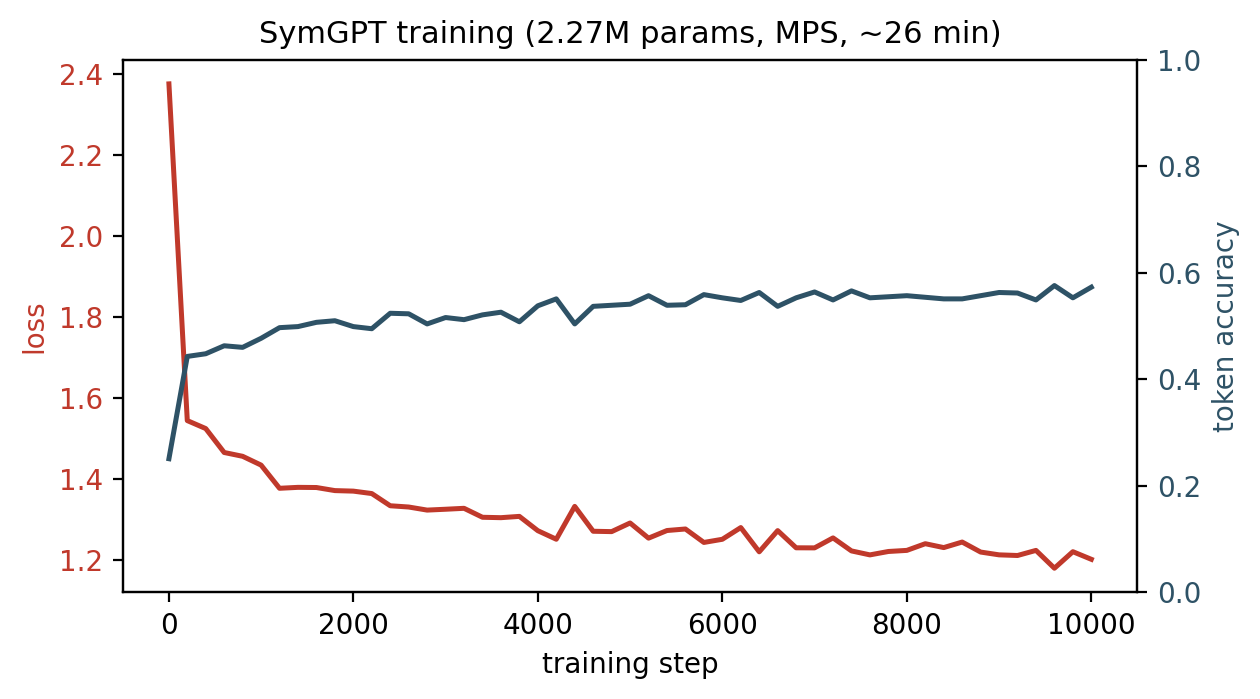
Trained on a stream of fresh random expressions — 2.27 million parameters, ten
thousand steps, about twenty-six minutes on a laptop GPU — the loss falls and
token accuracy climbs past one in two. Token accuracy looks modest, but it
understates the model badly, because getting a formula right does not
require reproducing the training tree token for token. The real test is whether
the predicted skeleton, once its constants are fit, reproduces the data.
Does it recover formulas it has never seen?
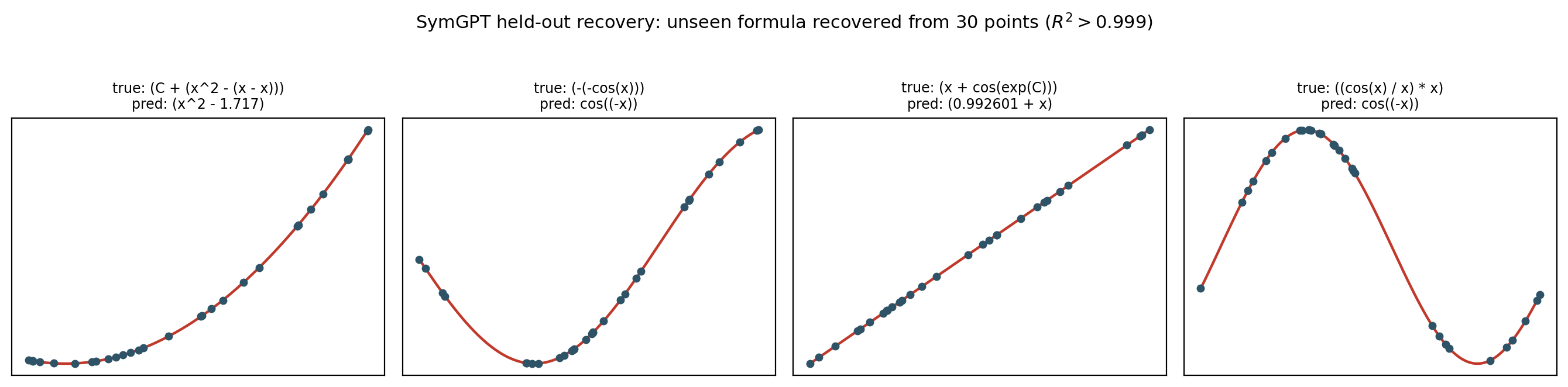
On held-out expressions the model has never encountered, the median
R2 after constant-fitting is 1.0, with clean recovery
on sixteen of twenty-five. And the way it succeeds is the interesting part — it
is not memorizing trees, it is finding functions. Handed data from
cos(x)⋅x/x it returns cos(x); handed
x−(x2−x2) it returns x. It has learned the
function behind the points, not the particular algebra that generated them,
which is exactly what recovering a law means.
held-out recovery (fresh formulas, never seen in training): true: mul div cos x x x -> pred: cos(x) R2 = 1.0000 <- cancelled x/x true: sub x sub mul x x sq x -> pred: x R2 = 1.0000 <- saw x^2 - x^2 = 0 true: sq exp neg x -> pred: exp(-x)^2 R2 = 1.0000 true: sin add sub x x sq x -> pred: sin(x^2) R2 = 1.0000 <- dropped x - x = 0 true: exp sin x -> pred: exp(sin(x)) R2 = 1.0000 ... median R2 = 1.0000 recovered (R2 > 0.999): 16 / 25benchmark vs the genetic-programming engine (20 in-distribution problems): SymGPT greedy (one forward pass) recovered 3/20 20 ms / problem SymGPT beam-14 recovered 11/20 1075 ms / problem GP pop=500 gens=40 recovered 13/20 1436 ms / problem
Amortization versus search: the benchmark
Run the transformer head-to-head against the from-scratch genetic-programming
engine on the same twenty problems and the result is a draw, not a rout. The
GP search is a strong baseline: on these small,
in-distribution problems it edges recovery, thirteen against eleven. The
transformer matches it through beam search at a comparable wall-clock, and its
single greedy forward pass is sixty-five times faster but trades away most of
the recovery. At this toy scale, neither dominates. What the numbers do not
show — but the timeouts behind them do — is the axis where the transformer wins:
its inference cost is flat, independent of how hard the formula is,
while a search's cost balloons with problem difficulty. Push the GP toward
harder targets and it needs far larger populations and generations to keep up,
while the trained model answers in the same fixed pass. Amortization is the
whole point: you pay the training cost once and buy constant-time inference
forever.
Better together: cross-seeding the search
The benchmark frames the two engines as rivals, but they are more useful as
collaborators, and the fix costs nothing at training time. The transformer
produces, in one pass, a few high-quality skeleton guesses; the genetic search
produces a whole population of expressions it evaluates and mostly discards.
Feed each to the other — seed the genetic population with the transformer's beam
predictions so the search starts near good structure instead of at random, and
pool the search's Pareto front back into the transformer's candidate set so the
best expression overall is returned. It is pure inference-time composition,
neural-guided genetic programming in the lineage of Deep Symbolic Optimization.
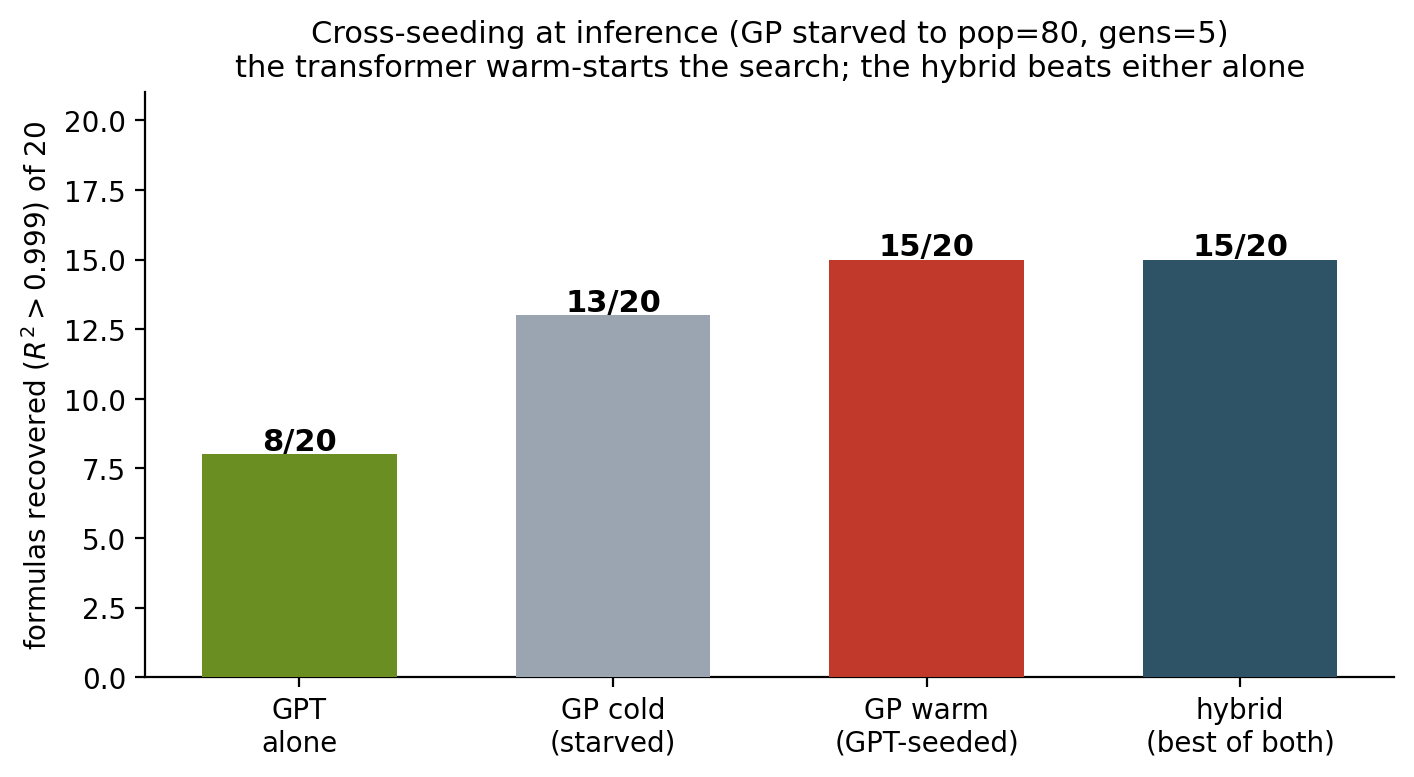
The warm start earns its keep exactly when search is expensive. Starve the
genetic engine to a small population and a few generations and it recovers 13 of
20 held-out formulas alone; seed it with the transformer's guesses and it
recovers 15, while the transformer by itself — fast but limited — gets 8. One
case shows the mechanism cleanly: on a formula where the transformer stalls at
R2=0.90 and the starved search stalls at 0.84, the
search refining the transformer's imperfect guess lands exactly. Structure from
the transformer, refinement from the search, and the hybrid beats either alone.
The benefit fades once you can afford a large search — which finds the answer
unaided — so the composition matters most under a tight compute budget, which is
the regime that motivated the amortized model to begin with.
What makes it hard, and what real systems add
The grammar must contain the answer. This model was trained on a nine-operator grammar with no log or ; hand it data from a logarithm and it cannot emit the token, so it approximates and fails cleanly. As with every symbolic method, the operator set is the hypothesis class — production models (Kamienny, Biggio) train on far richer grammars and multiple input variables.
Generalization is in-distribution. The model is only as good as the distribution it was trained on. Expressions deeper or stranger than its training rungs are out-of-distribution, and recovery degrades — the failure mode a search does not have, since a search explores rather than recalls.
Beam width trades speed for recovery. Greedy decoding commits to the highest-probability token at every step and often paints itself into a corner; a beam keeps several candidate skeletons alive and fits constants to each. That one knob moved recovery from three-in-twenty to eleven-in-twenty here.
Skeleton then constants. The split — transformer predicts structure, least-squares fits the numbers — is what real systems (SymbolicGPT, NeSymReS) do too. The alternative, generating digits of constants as tokens, is far harder to train and less accurate than handing the numbers to an optimizer.
The point, for a computational scientist
The genetic search and SISSO give you a formula for one table; the
transformer gives you a function from tables to formulas. That is what you want
when the fitting is inside a loop — screening thousands of candidate
materials, tagging every trajectory in a simulation with the closed form of its
transient, distilling a controller's learned policy on the fly — anywhere the
per-problem cost of a fresh search is the bottleneck. It is the amortized member
of the symbolic-regressioncanon: search, compressed sensing, and now
learning, three routes from a column of numbers to an equation, each strongest
where the others are weak.
Try First
Each prompt asks a checkable question about the working code or math
above — predict an output, derive a sign, state an invariant, find a
bug. Commit to an answer before clicking "reveal." That commitment is
the whole point: if your answer matched, you understand the piece you
were looking at; if it didn't, that's the part worth re-reading.
predict
The model predicts a skeleton — the formula with every constant
replaced by one placeholder token C — and the numbers are fit
afterward. Why is this dramatically easier to train than a model that
generates the digits of each constant directly?
answer
Because it removes an infinite, high-precision regression problem from the
thing the network has to learn and leaves it with a finite, discrete one.
Generating 3.14159… token by token asks the model to be a
calculator: a one-digit slip anywhere ruins the value, the targets are
effectively continuous, and cross-entropy over digits is a terrible proxy
for numerical closeness. Predicting a single C placeholder
collapses all of that to one token — the model only has to decide
that a constant goes here, not which — so the whole output
space is a small vocabulary of structures. The actual value is then handed
to a least-squares optimizer, which solves the continuous problem exactly
and in closed form for linear cases. Structure to the network, numbers to
the optimizer: each tool does the part it is good at.
why does this work
On the benchmark the transformer does not beat the genetic-programming search
on small problems — GP even edges it. So what is the case for training a
transformer at all, rather than just running the search each time?
answer
The case is the shape of the cost curve, not the score on easy problems. A
search pays its full price on every problem, and that price grows
with difficulty — a harder formula needs a bigger population, more
generations, a longer sweep. The transformer pays a large cost once,
at training, and then answers every future problem in a fixed forward pass
whose cost does not depend on how hard the formula is. So the two curves
cross: for a handful of easy one-off fits, the search is the right tool and
the training cost is never amortized. For a pipeline that has to fit
thousands of tables, or fit them inside a tight loop, or fit hard ones where
the search would need an enormous budget, the flat inference cost wins
decisively. You train the model when you are going to ask the question many
times, which is precisely the regime a screening or simulation campaign
lives in.
Reproduce it
The engine lives in scripts/symgpt/: data.py
generates the synthetic (points, prefix) stream and proves the tree↔sequence
round-trip exact; model.py is the decoder with its
point-embedding prefix and hand-built attention mask; train.py
streams fresh batches to a saved checkpoint; infer.py beam-decodes
a skeleton and fits its constants by least squares; and
benchmark.py runs the head-to-head against the genetic-programming
engine. Retrain on a wider grammar, add input variables, or swap greedy for a
wider beam and watch recovery move.