Chebyshev Polynomial Root Distribution
Spectral Methods
What you need to know first 1 concepts, 1 layers
The requisite-knowledge inventory for this page, bottom-up: the primitives at the base, combined upward until you reach what this page assumes. Skim the layers you already own; start wherever the ground gets unfamiliar.
- base
- Linear algebraconcept
- ↳you are here
1 of these are concepts without a dedicated page yet — the grey chips. Following the linked ones first makes the rest land.
This page explores the distribution of roots of random Chebyshev polynomials, comparing unconstrained coefficients with coefficients constrained to lie on a hypersphere.
Chebyshev Polynomials
Chebyshev polynomials of the first kind are defined by the recurrence relation:
A random Chebyshev polynomial of degree can be constructed as:
where are random coefficients.
Constrained vs Unconstrained
We compare two ensembles:
- Unconstrained: (standard normal)
- Hypersphere: normalized to lie on a hypersphere of radius
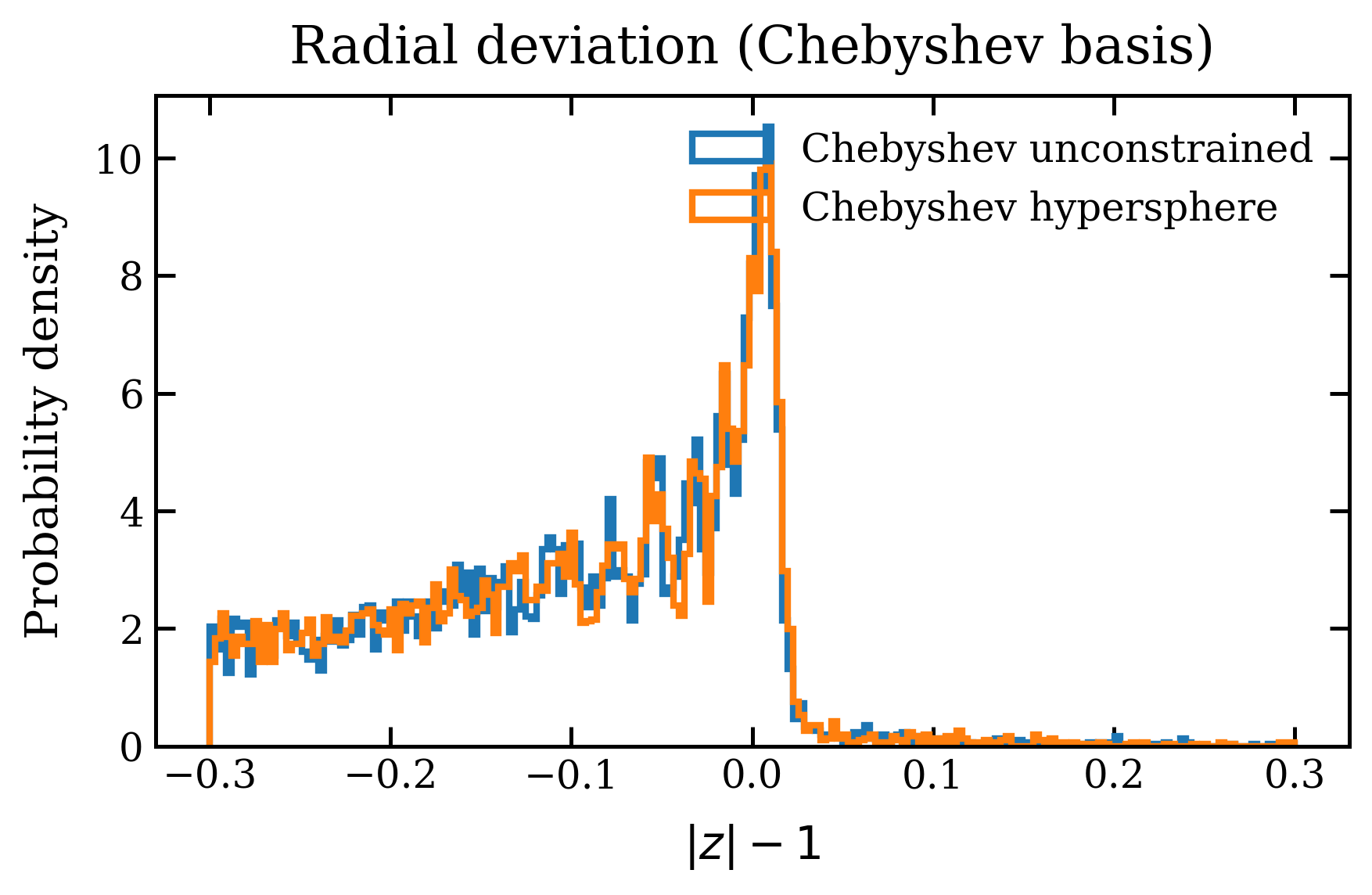
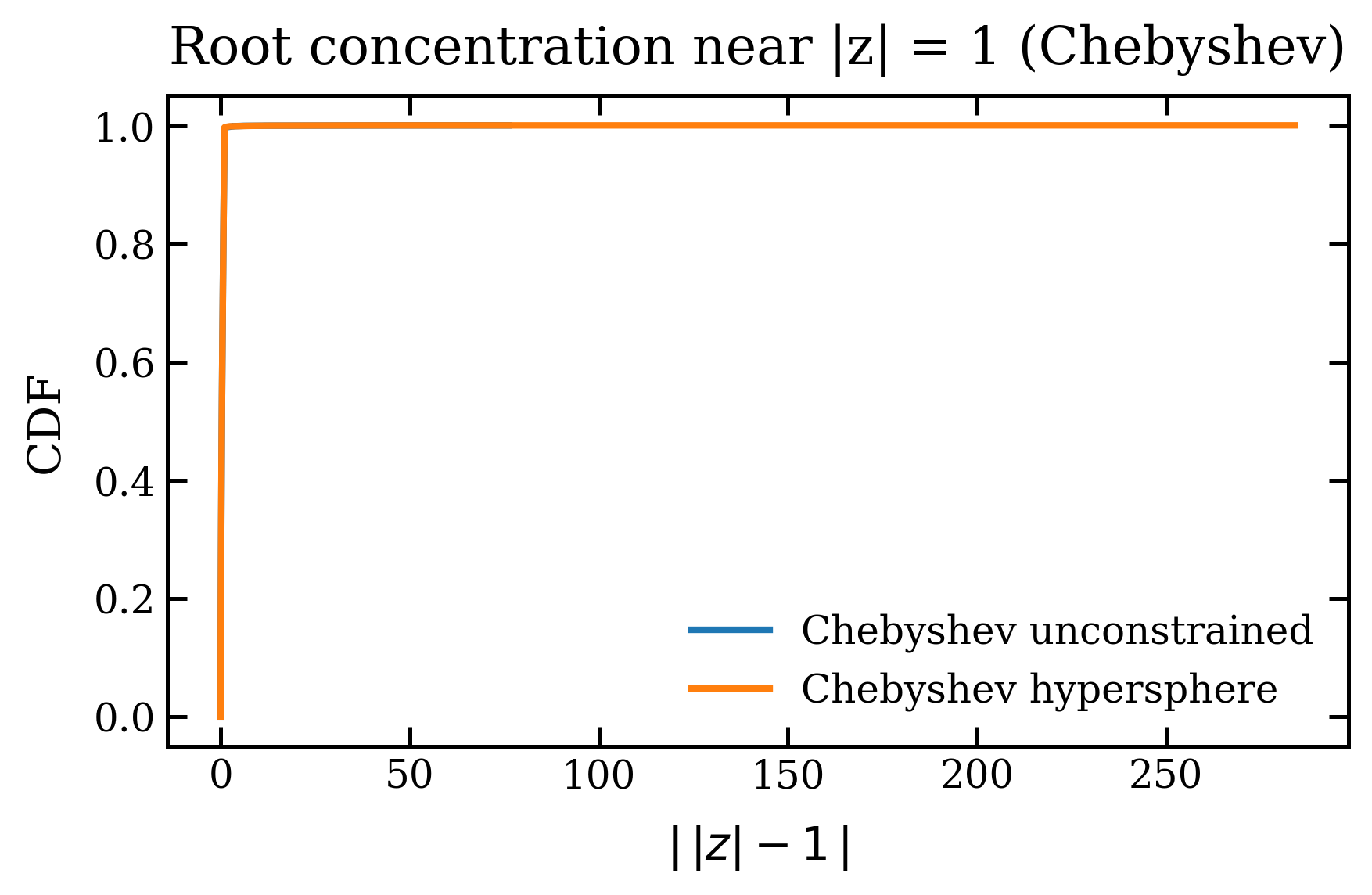
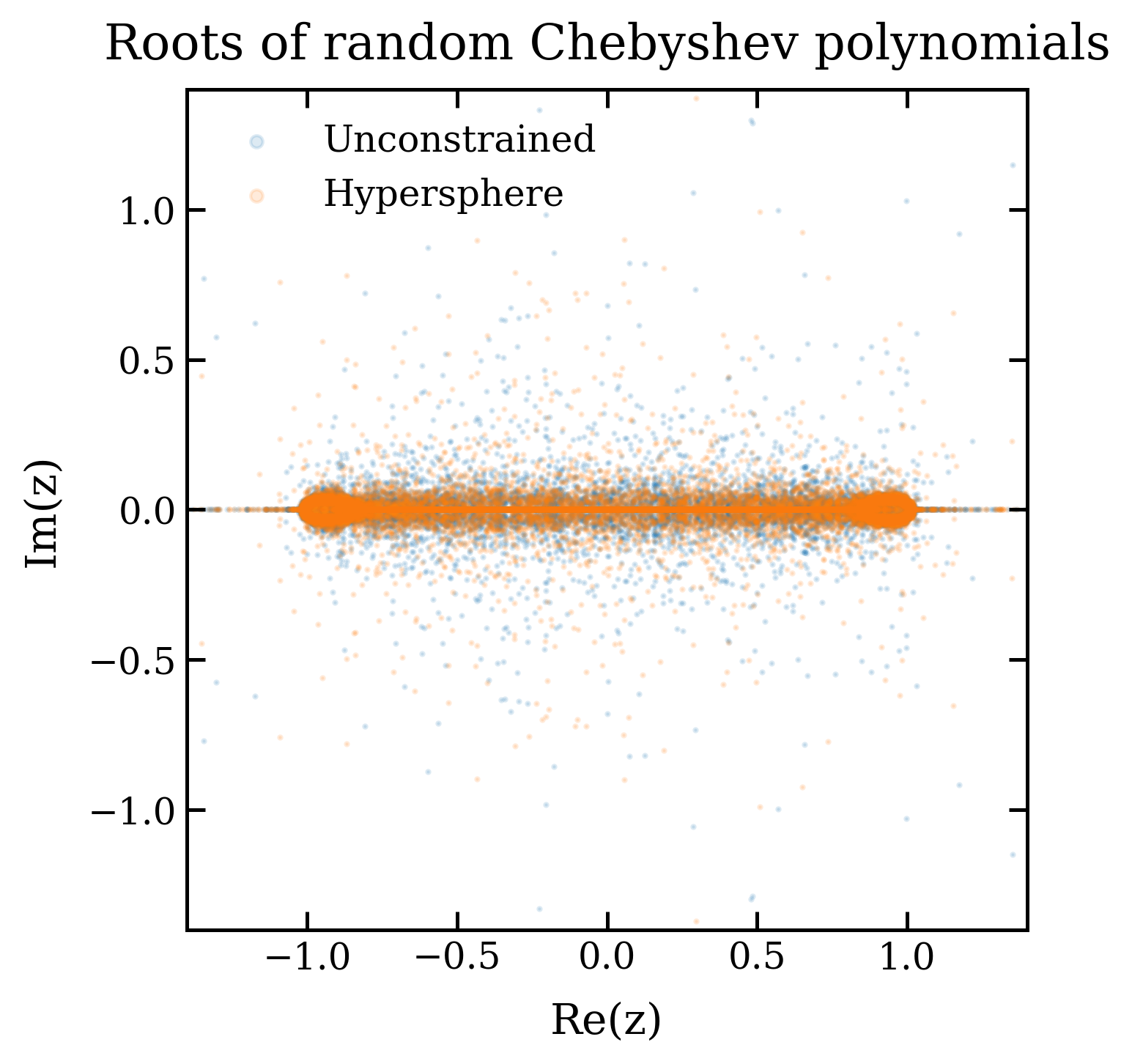
The root distribution shows interesting concentration properties near the unit circle.
Implementation
The following code samples roots from both ensembles and analyzes their distribution:
import numpy as np
import matplotlib.pyplot as plt
import matplotlib as mpl

def set_publication_style():
    """Set publication-quality matplotlib style."""
    mpl.rcParams.update({
        'font.family': 'serif',
        'font.size': 12,
        'axes.labelsize': 14,
        'axes.titlesize': 16,
        'axes.linewidth': 1.2,
        'axes.labelpad': 8,
        'axes.titlepad': 10,
        'xtick.labelsize': 12,
        'ytick.labelsize': 12,
        'xtick.direction': 'in',
        'ytick.direction': 'in',
        'xtick.top': True,
        'ytick.right': True,
        'xtick.major.size': 6,
        'ytick.major.size': 6,
        'xtick.major.width': 1.2,
        'ytick.major.width': 1.2,
        'legend.fontsize': 12,
        'legend.frameon': False,
        'lines.linewidth': 2,
        'lines.markersize': 6,
        'figure.dpi': 100,
        'savefig.dpi': 300,
        'savefig.bbox': 'tight'
    })

set_publication_style()
from numpy.polynomial import Chebyshev, Polynomial

# ---------------- PARAMETERS ----------------
degree = 50
num_polys = 400
radius = 1.0
seed = 0

np.random.seed(seed)

# ---------------- CHEBYSHEV GENERATORS ----------------
def cheb_unconstrained(n):
    return np.random.randn(n + 1)

def cheb_on_sphere(n, R=1.0):
    c = np.random.randn(n + 1)
    return c * (R / np.linalg.norm(c))

# ---------------- SAMPLE ROOTS ----------------
def sample_roots_cheb(gen):
    roots = []
    for _ in range(num_polys):
        c = gen(degree)

        # Chebyshev polynomial → monomial polynomial
        T = Chebyshev(c)
        P = T.convert(kind=Polynomial)

        roots.append(P.roots())
    return np.concatenate(roots)

roots_un = sample_roots_cheb(cheb_unconstrained)
roots_con = sample_roots_cheb(cheb_on_sphere)

# ---------------- RADIAL DATA ----------------
du = np.abs(roots_un) - 1.0
dc = np.abs(roots_con) - 1.0

# ---------------- PDF OF r - 1 ----------------
bins = np.linspace(-0.3, 0.3, 200)

plt.figure(figsize=(6,4))
plt.hist(du, bins=bins, density=True, histtype="step",
         linewidth=2, label="Chebyshev unconstrained")
plt.hist(dc, bins=bins, density=True, histtype="step",
         linewidth=2, label="Chebyshev hypersphere")
plt.xlabel(r"$|z| - 1$")
plt.ylabel("Probability density")
plt.title("Radial deviation (Chebyshev basis)")
plt.legend()
plt.tight_layout()
plt.savefig('figures/chebyshev_roots_pdf.png', dpi=300, bbox_inches='tight')
plt.show()

# ---------------- CDF OF |r - 1| ----------------
xu = np.sort(np.abs(du))
xc = np.sort(np.abs(dc))

Fu = np.arange(1, len(xu)+1) / len(xu)
Fc = np.arange(1, len(xc)+1) / len(xc)

plt.figure(figsize=(6,4))
plt.plot(xu, Fu, linewidth=2, label="Chebyshev unconstrained")
plt.plot(xc, Fc, linewidth=2, label="Chebyshev hypersphere")
plt.xlabel(r"$|\,|z| - 1\,|$")
plt.ylabel("CDF")
plt.title("Root concentration near |z| = 1 (Chebyshev)")
plt.legend()
plt.tight_layout()
plt.savefig('figures/chebyshev_roots_cdf.png', dpi=300, bbox_inches='tight')
plt.show()

# ---------------- COMPLEX PLANE (ZOOMED) ----------------
Rmax = 1.4

plt.figure(figsize=(5,5))
plt.scatter(roots_un.real, roots_un.imag,
            s=1, alpha=0.15, label="Unconstrained")
plt.scatter(roots_con.real, roots_con.imag,
            s=1, alpha=0.15, label="Hypersphere")
plt.gca().set_aspect("equal")
plt.xlim(-Rmax, Rmax)
plt.ylim(-Rmax, Rmax)
plt.xlabel("Re(z)")
plt.ylabel("Im(z)")
plt.title("Roots of random Chebyshev polynomials")
plt.legend(markerscale=4)
plt.tight_layout()
plt.savefig('figures/chebyshev_roots_complex.png', dpi=300, bbox_inches='tight')
plt.show()

# ---------------- NUMERICAL SUMMARY ----------------
print("Std(|r-1|) for Chebyshev ensemble:")
print("  Unconstrained :", np.std(du))
print("  Hypersphere   :", np.std(dc))
Visualization
The following plots show the distribution of Chebyshev polynomial roots:
Key Observations
- Roots of random Chebyshev polynomials tend to cluster near the unit circle
- Constraining coefficients to a hypersphere affects the root distribution
- The standard deviation of provides a measure of root concentration
- Visualization in the complex plane reveals the distribution pattern