Zone Folding
Solid State Physics
What you need to know first 1 concepts, 1 layers
The requisite-knowledge inventory for this page, bottom-up: the primitives at the base, combined upward until you reach what this page assumes. Skim the layers you already own; start wherever the ground gets unfamiliar.
- base
- ↳you are here
import numpy as np
import matplotlib.pyplot as plt
import matplotlib as mpl

def set_publication_style():
    """Set publication-quality matplotlib style."""
    mpl.rcParams.update({
        'font.family': 'serif',
        'font.size': 12,
        'axes.labelsize': 14,
        'axes.titlesize': 16,
        'axes.linewidth': 1.2,
        'axes.labelpad': 8,
        'axes.titlepad': 10,
        'xtick.labelsize': 12,
        'ytick.labelsize': 12,
        'xtick.direction': 'in',
        'ytick.direction': 'in',
        'xtick.top': True,
        'ytick.right': True,
        'xtick.major.size': 6,
        'ytick.major.size': 6,
        'xtick.major.width': 1.2,
        'ytick.major.width': 1.2,
        'legend.fontsize': 12,
        'legend.frameon': False,
        'lines.linewidth': 2,
        'lines.markersize': 6,
        'figure.dpi': 100,
        'savefig.dpi': 300,
        'savefig.bbox': 'tight'
    })

set_publication_style()
from matplotlib import cm
from matplotlib.colors import ListedColormap
from matplotlib import rcParams

# Publication-quality settings
rcParams.update({
    'font.family': 'serif',
    'font.size': 12,
    'axes.labelsize': 14,
    'axes.titlesize': 15,
    'legend.fontsize': 12,
    'xtick.labelsize': 12,
    'ytick.labelsize': 12,
    'figure.dpi': 300
})

# Constants (arbitrary units)
hbar = 1
m = 1
a = 1
G = 2 * np.pi / a  # reciprocal lattice vector

# Create k-points well beyond first BZ
k = np.linspace(-5 * G, 5 * G, 2000)
E = hbar**2 * k**2 / (2 * m)

# Fold k into first BZ [-G/2, G/2]
k_folded = ((k + G/2) % G) - G/2

# Identify zone index for each point
zone_index = np.round((k - k_folded) / G).astype(int)

zone_colors = [
    '#332288',  # dark blue
    '#88CCEE',  # light blue
    '#44AA99',  # teal
    '#117733',  # green
    '#999933',  # olive
    '#DDCC77',  # sand
    '#661100',  # brown
    '#CC6677',  # pink
    '#882255',  # wine
    '#AA4499'   # purple
]


num_zones = len(zone_colors)
cmap = ListedColormap(zone_colors[:num_zones])

# Plot settings
plt.figure(figsize=(12, 6))

# Plot the original parabola with colored segments
for n in range(-5, 6):
    mask = zone_index == n
    if np.any(mask):
        plt.plot(k[mask], E[mask], color=zone_colors[n % num_zones], linewidth=2)

# Plot the folded band structure with matching colors
for n in range(-5, 6):
    mask = zone_index == n
    if np.any(mask):
        # Sort by folded k for smooth plotting
        kf = k_folded[mask]
        Ef = E[mask]
        idx = np.argsort(kf)
        plt.plot(kf[idx], Ef[idx], color=zone_colors[n % num_zones], linewidth=2,
                 label=f'Zone {n}')

# Brillouin zone boundaries
plt.axvline(-G/2, color='black', linestyle='--', linewidth=1)
plt.axvline(G/2, color='black', linestyle='--', linewidth=1)

# Brillouin zone boundaries
for i in range(1,5):
    plt.axvline(-G/2 + i*(-G), color='gray', linestyle='--', linewidth=1)
    plt.axvline(G/2 + i*G, color='gray', linestyle='--', linewidth=1)

# Labels and formatting
plt.xlabel(r'Wave vector $k$ (1/a)', fontsize=14)
plt.ylabel(r'Energy $E(k)$ (arb. units)', fontsize=14)
plt.title('Free Electron Band Structure in 1D', fontsize=16)
#plt.legend(title='From original zone:', loc='lower right', fontsize=10)
plt.grid(True, which='both', linestyle=':', alpha=0.5)
plt.tight_layout()
plt.savefig('figures/zone_folding.png', dpi=300, bbox_inches='tight')
plt.show()
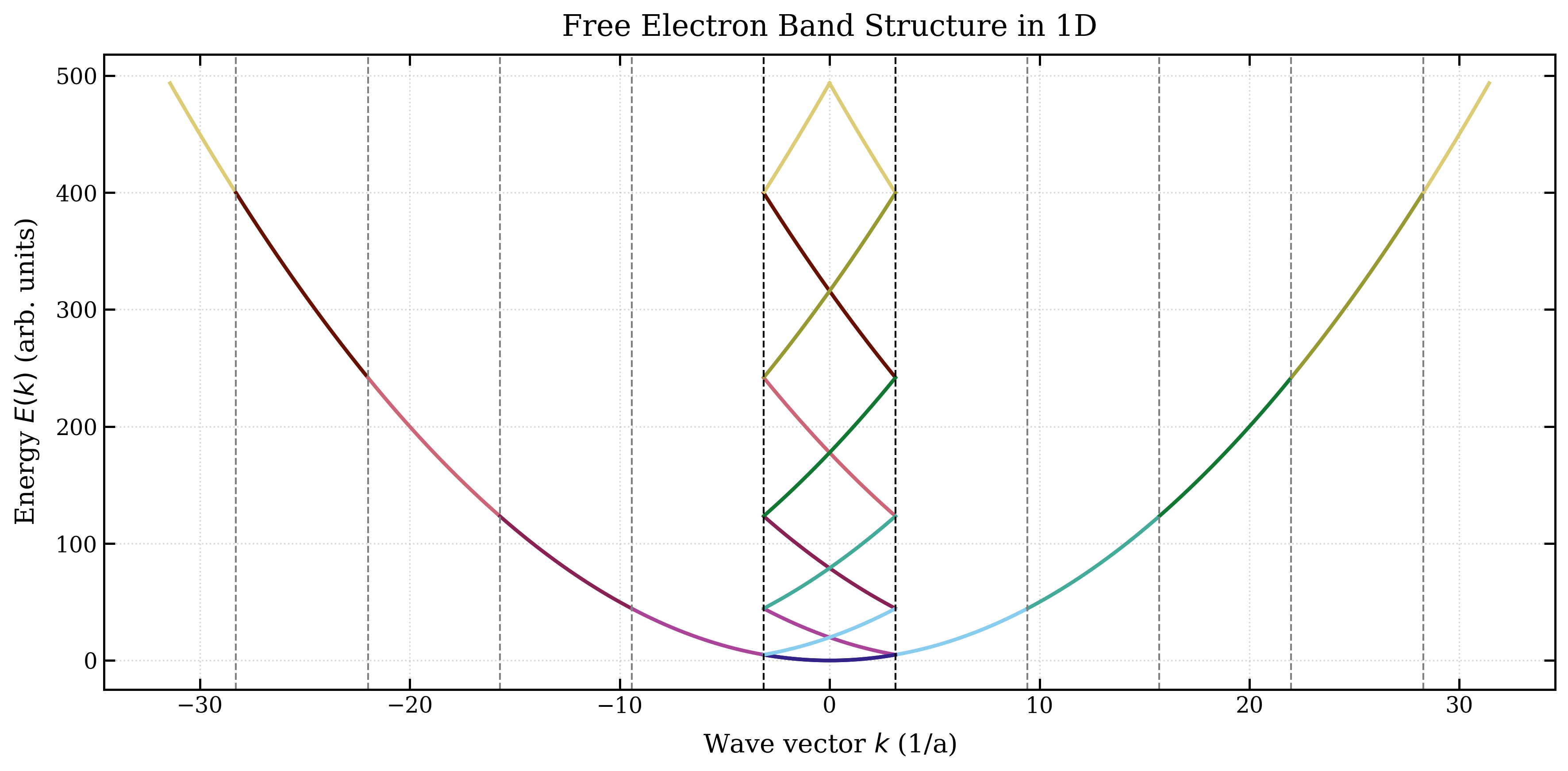
Visualization
The following plot shows the free electron band structure with zone folding: