Monte Carlo Option Pricing
Finance
What you need to know first 1 concepts, 1 layers
The requisite-knowledge inventory for this page, bottom-up: the primitives at the base, combined upward until you reach what this page assumes. Skim the layers you already own; start wherever the ground gets unfamiliar.
- base
- ↳you are here
Monte Carlo simulation is a powerful numerical method for pricing options, especially when analytical solutions are not available. It works by simulating many possible future stock price paths and averaging the payoffs.
Geometric Brownian Motion
We model the stock price using geometric Brownian motion:
In the risk-neutral world, . The solution is:
For discrete time steps, we use:
where is a standard normal random variable.
Monte Carlo Method
The Monte Carlo method for option pricing:
- Simulate stock price paths to expiration
- Calculate the payoff for each path
- Average the payoffs and discount to present value
The option price is estimated as:
The standard error decreases as , so more simulations improve accuracy.
Payoff Functions
For a European call option:
For a European put option:
where is the stock price at expiration and is the strike price.
Python Implementation
The following code implements Monte Carlo option pricing:
import numpy as np
import matplotlib.pyplot as plt
import matplotlib as mpl
from scipy.stats import norm

def set_publication_style():
    """Set publication-quality matplotlib style."""
    mpl.rcParams.update({
        'font.family': 'serif',
        'font.size': 12,
        'axes.labelsize': 14,
        'axes.titlesize': 16,
        'axes.linewidth': 1.2,
        'axes.labelpad': 8,
        'axes.titlepad': 10,
        'xtick.labelsize': 12,
        'ytick.labelsize': 12,
        'xtick.direction': 'in',
        'ytick.direction': 'in',
        'xtick.top': True,
        'ytick.right': True,
        'xtick.major.size': 6,
        'ytick.major.size': 6,
        'xtick.major.width': 1.2,
        'ytick.major.width': 1.2,
        'legend.fontsize': 12,
        'legend.frameon': False,
        'lines.linewidth': 2,
        'lines.markersize': 6,
        'figure.dpi': 100,
        'savefig.dpi': 300,
        'savefig.bbox': 'tight'
    })

set_publication_style()

def black_scholes(S, K, T, r, sigma, option_type='call'):
    """Black-Scholes analytical formula for comparison."""
    d1 = (np.log(S / K) + (r + 0.5 * sigma**2) * T) / (sigma * np.sqrt(T))
    d2 = d1 - sigma * np.sqrt(T)

    if option_type == 'call':
        return S * norm.cdf(d1) - K * np.exp(-r * T) * norm.cdf(d2)
    else:
        return K * np.exp(-r * T) * norm.cdf(-d2) - S * norm.cdf(-d1)

def monte_carlo_option_price(S0, K, T, r, sigma, n_simulations, option_type='call', n_steps=1):
    """
    Price European option using Monte Carlo simulation.

    Parameters
    ----------
    S0 : float
        Initial stock price
    K : float
        Strike price
    T : float
        Time to expiration (years)
    r : float
        Risk-free rate
    sigma : float
        Volatility
    n_simulations : int
        Number of Monte Carlo simulations
    option_type : str
        'call' or 'put'
    n_steps : int
        Number of time steps (1 for simple simulation)

    Returns
    -------
    tuple
        Option price, standard error, payoffs array
    """
    np.random.seed(42)  # For reproducibility

    dt = T / n_steps

    # Simulate stock prices
    if n_steps == 1:
        # Simple one-step simulation
        Z = np.random.normal(0, 1, n_simulations)
        ST = S0 * np.exp((r - 0.5 * sigma**2) * T + sigma * np.sqrt(T) * Z)
    else:
        # Multi-step simulation
        ST = np.zeros(n_simulations)
        S = np.full(n_simulations, S0)

        for _ in range(n_steps):
            Z = np.random.normal(0, 1, n_simulations)
            S *= np.exp((r - 0.5 * sigma**2) * dt + sigma * np.sqrt(dt) * Z)

        ST = S

    # Calculate payoffs
    if option_type == 'call':
        payoffs = np.maximum(ST - K, 0)
    else:
        payoffs = np.maximum(K - ST, 0)

    # Discount to present value and calculate statistics
    option_price = np.exp(-r * T) * np.mean(payoffs)
    standard_error = np.exp(-r * T) * np.std(payoffs) / np.sqrt(n_simulations)

    return option_price, standard_error, payoffs

def simulate_stock_paths(S0, mu, sigma, T, dt, n_paths):
    """
    Simulate multiple stock price paths using geometric Brownian motion.

    Parameters
    ----------
    S0 : float
        Initial stock price
    mu : float
        Drift (expected return)
    sigma : float
        Volatility
    T : float
        Total time
    dt : float
        Time step
    n_paths : int
        Number of paths to simulate

    Returns
    -------
    ndarray
        Array of stock price paths
    """
    n_steps = int(T / dt)
    paths = np.zeros((n_paths, n_steps + 1))
    paths[:, 0] = S0

    for i in range(1, n_steps + 1):
        Z = np.random.normal(0, 1, n_paths)
        paths[:, i] = paths[:, i-1] * np.exp((mu - 0.5 * sigma**2) * dt + sigma * np.sqrt(dt) * Z)

    return paths

# Parameters
S0 = 100  # Initial stock price
K = 100   # Strike price
T = 1.0   # Time to expiration (1 year)
r = 0.05  # Risk-free rate (5%)
sigma = 0.2  # Volatility (20%)
n_simulations = 100000  # Number of Monte Carlo simulations

# Calculate option prices
call_price_mc, call_se, call_payoffs = monte_carlo_option_price(
    S0, K, T, r, sigma, n_simulations, 'call'
)
put_price_mc, put_se, put_payoffs = monte_carlo_option_price(
    S0, K, T, r, sigma, n_simulations, 'put'
)

# Compare with Black-Scholes
call_price_bs = black_scholes(S0, K, T, r, sigma, 'call')
put_price_bs = black_scholes(S0, K, T, r, sigma, 'put')

print("Monte Carlo Option Pricing Results:")
print("\nCall Option:")
print("  Monte Carlo: {:.4f} ± {:.4f}".format(call_price_mc, call_se))
print("  Black-Scholes: {:.4f}".format(call_price_bs))
print("  Difference: {:.4f}".format(abs(call_price_mc - call_price_bs)))
print("  Relative Error: {:.2f}%".format(100*abs(call_price_mc - call_price_bs)/call_price_bs))

print("\nPut Option:")
print("  Monte Carlo: {:.4f} ± {:.4f}".format(put_price_mc, put_se))
print("  Black-Scholes: {:.4f}".format(put_price_bs))
print("  Difference: {:.4f}".format(abs(put_price_mc - put_price_bs)))
print("  Relative Error: {:.2f}%".format(100*abs(put_price_mc - put_price_bs)/put_price_bs))

# Plot 1: Simulated stock price paths
n_paths_plot = 20
dt = 1/252  # Daily steps
paths = simulate_stock_paths(S0, r, sigma, T, dt, n_paths_plot)
time = np.linspace(0, T, paths.shape[1])

fig, axes = plt.subplots(2, 2, figsize=(14, 10))

# Top left: Stock price paths
axes[0, 0].plot(time, paths.T, alpha=0.6, linewidth=0.5)
axes[0, 0].axhline(K, color='r', linestyle='--', linewidth=2, label='Strike Price')
axes[0, 0].set_xlabel('Time (years)')
axes[0, 0].set_ylabel('Stock Price')
axes[0, 0].set_title('Simulated Stock Price Paths')
axes[0, 0].legend()
axes[0, 0].grid(True, alpha=0.3)

# Top right: Payoff distribution (call)
axes[0, 1].hist(np.exp(-r*T) * call_payoffs, bins=50, alpha=0.7, edgecolor='black')
axes[0, 1].axvline(call_price_mc, color='r', linestyle='--', linewidth=2, label='Mean: {:.2f}'.format(call_price_mc))
axes[0, 1].axvline(call_price_bs, color='g', linestyle='--', linewidth=2, label='BS: {:.2f}'.format(call_price_bs))
axes[0, 1].set_xlabel('Discounted Payoff')
axes[0, 1].set_ylabel('Frequency')
axes[0, 1].set_title('Call Option Payoff Distribution')
axes[0, 1].legend()
axes[0, 1].grid(True, alpha=0.3)

# Bottom left: Payoff distribution (put)
axes[1, 0].hist(np.exp(-r*T) * put_payoffs, bins=50, alpha=0.7, edgecolor='black', color='orange')
axes[1, 0].axvline(put_price_mc, color='r', linestyle='--', linewidth=2, label='Mean: {:.2f}'.format(put_price_mc))
axes[1, 0].axvline(put_price_bs, color='g', linestyle='--', linewidth=2, label='BS: {:.2f}'.format(put_price_bs))
axes[1, 0].set_xlabel('Discounted Payoff')
axes[1, 0].set_ylabel('Frequency')
axes[1, 0].set_title('Put Option Payoff Distribution')
axes[1, 0].legend()
axes[1, 0].grid(True, alpha=0.3)

# Bottom right: Convergence analysis
n_sims_range = [1000, 5000, 10000, 50000, 100000, 500000]
call_prices_conv = []
put_prices_conv = []

for n in n_sims_range:
    call_p, _, _ = monte_carlo_option_price(S0, K, T, r, sigma, n, 'call')
    put_p, _, _ = monte_carlo_option_price(S0, K, T, r, sigma, n, 'put')
    call_prices_conv.append(call_p)
    put_prices_conv.append(put_p)

axes[1, 1].semilogx(n_sims_range, call_prices_conv, 'b-o', label='Call (MC)')
axes[1, 1].semilogx(n_sims_range, put_prices_conv, 'r-o', label='Put (MC)')
axes[1, 1].axhline(call_price_bs, color='b', linestyle='--', alpha=0.5, label='Call (BS)')
axes[1, 1].axhline(put_price_bs, color='r', linestyle='--', alpha=0.5, label='Put (BS)')
axes[1, 1].set_xlabel('Number of Simulations')
axes[1, 1].set_ylabel('Option Price')
axes[1, 1].set_title('Monte Carlo Convergence')
axes[1, 1].legend()
axes[1, 1].grid(True, alpha=0.3)

plt.tight_layout()
plt.savefig('figures/monte_carlo_options_plot.png', dpi=300, bbox_inches='tight')
plt.show()
Visualization
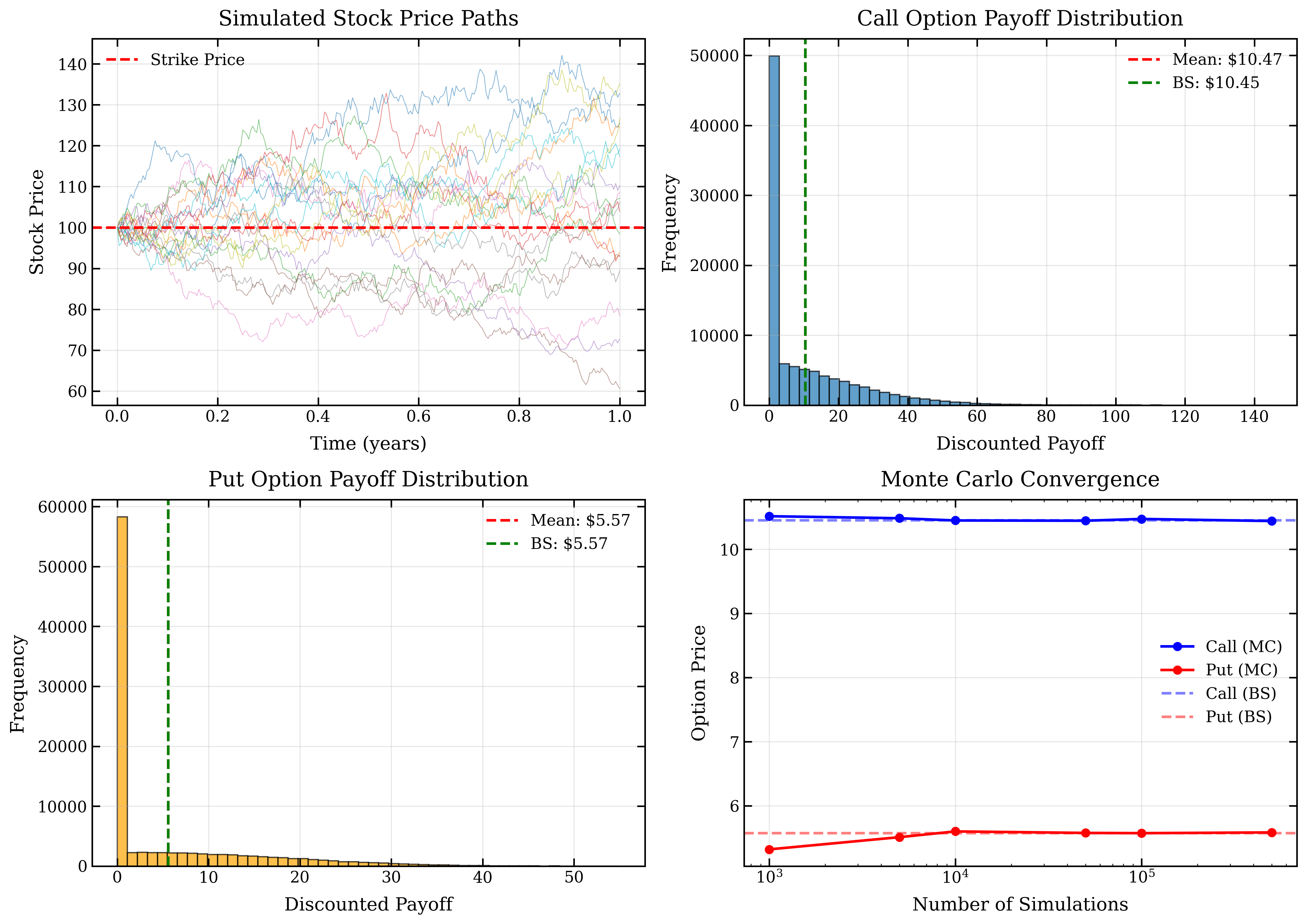
The following plots show simulated stock price paths, payoff distributions, and convergence analysis:
Advantages
Monte Carlo simulation offers several advantages:
- Flexibility: Can handle complex payoffs and path-dependent options
- Multi-dimensional: Easy to extend to multiple assets
- Stochastic volatility: Can incorporate time-varying volatility
- American options: Can price early exercise using least squares Monte Carlo
- Intuitive: Direct simulation of the underlying process
Variance Reduction
Several techniques can reduce the variance of Monte Carlo estimates:
- Antithetic variates: Use along with
- Control variates: Use known analytical solutions
- Importance sampling: Change the probability measure
- Quasi-Monte Carlo: Use low-discrepancy sequences
Applications
Monte Carlo is used for:
- Exotic options (Asian, barrier, lookback)
- Basket options and correlation products
- Options with stochastic volatility
- Real options and project valuation
- Risk management and stress testing