Fourier Series and Cesàro Summation
Series
This page demonstrates Fourier series expansion and the Cesàro (Fejér) summation method, which can reduce Gibbs phenomenon oscillations.
Fourier Series
For a function with period (so the integration interval is ), the Fourier series is:
where the coefficients are:
The factor of 2 inside the trig arguments matters. With basis and , the basis functions have period , the fundamental period is , and the basis is orthogonal on with norm . That orthogonality is what makes the normalization recover the coefficients exactly. If you instead use on (period ), the sine and cosine families are no longer mutually orthogonal there, and the partial sum will not converge to .
Cesàro (Fejér) Summation
The classical partial sum can exhibit Gibbs phenomenon near discontinuities. The Cesàro sum averages the partial sums:
This averaging reduces oscillations and provides better convergence behavior.
Implementation
The following code computes Fourier coefficients using the trapezoidal rule and compares classical and Cesàro summation:
import numpy as np
import matplotlib.pyplot as plt
import matplotlib as mpl

def set_publication_style():
    """Set publication-quality matplotlib style."""
    mpl.rcParams.update({
        'font.family': 'serif',
        'font.size': 12,
        'axes.labelsize': 14,
        'axes.titlesize': 16,
        'axes.linewidth': 1.2,
        'axes.labelpad': 8,
        'axes.titlepad': 10,
        'xtick.labelsize': 12,
        'ytick.labelsize': 12,
        'xtick.direction': 'in',
        'ytick.direction': 'in',
        'xtick.top': True,
        'ytick.right': True,
        'xtick.major.size': 6,
        'ytick.major.size': 6,
        'xtick.major.width': 1.2,
        'ytick.major.width': 1.2,
        'legend.fontsize': 12,
        'legend.frameon': False,
        'lines.linewidth': 2,
        'lines.markersize': 6,
        'figure.dpi': 100,
        'savefig.dpi': 300,
        'savefig.bbox': 'tight'
    })

set_publication_style()

# -------- PARAMETERS --------
P = 2*np.pi   # interval length
N = 50        # highest Fourier mode
M = 20000     # grid for trapezoidal rule

# -------- FUNCTION --------
def f(x):
    return x**2

# Grid for integration
x_int = np.linspace(0, P, M)
fx = f(x_int)

# -------- COMPUTE FOURIER COEFFICIENTS --------
a = np.zeros(N+1)
b = np.zeros(N+1)

# a0
a[0] = (2/P) * np.trapz(fx, x_int)

# n >= 1
for n in range(1, N+1):
    a[n] = (2/P) * np.trapz(fx * np.cos(2*n*np.pi * x_int/P), x_int)
    b[n] = (2/P) * np.trapz(fx * np.sin(2*n*np.pi * x_int/P), x_int)

# -------- BUILD CLASSICAL FOURIER PARTIAL SUM S_N(x) --------
x_plot = np.linspace(0, P, 2000)
S = np.zeros((N+1, len(x_plot)))

# S_0 = a0/2
S[0, :] = a[0]/2

for k in range(1, N+1):
    S[k, :] = S[k-1, :] + a[k] * np.cos(2*k*np.pi*x_plot/P) + b[k] * np.sin(2*k*np.pi*x_plot/P)

S_N = S[N, :]  # classical partial sum

# -------- CESÀRO (FEJÉR) SUM: sigma_N = (1/(N+1)) * sum_{k=0}^N S_k --------
sigma_N = np.sum(S, axis=0) / (N+1)

# -------- PLOT RESULTS --------
plt.figure(figsize=(10, 6))
plt.plot(x_plot, x_plot**2, label="Actual $x^2$", linewidth=3)
plt.plot(x_plot, S_N, '--', label=f"Fourier Partial Sum (N={N}) w/ Gibbs")
plt.plot(x_plot, sigma_N, label=f"Fejér (Cesàro) Sum (N={N})", linewidth=3)
plt.xlabel("x")
plt.ylabel("f(x)")
plt.title("Fourier Series of $x^2$ on [0,P]: Classical vs. Cesàro Summation")
plt.grid(True)
plt.legend()
plt.savefig('figures/fourier_series_cesaro.png', dpi=300, bbox_inches='tight')
plt.show()
Visualization
The following plot shows the Fourier series approximation with and without Cesàro summation:
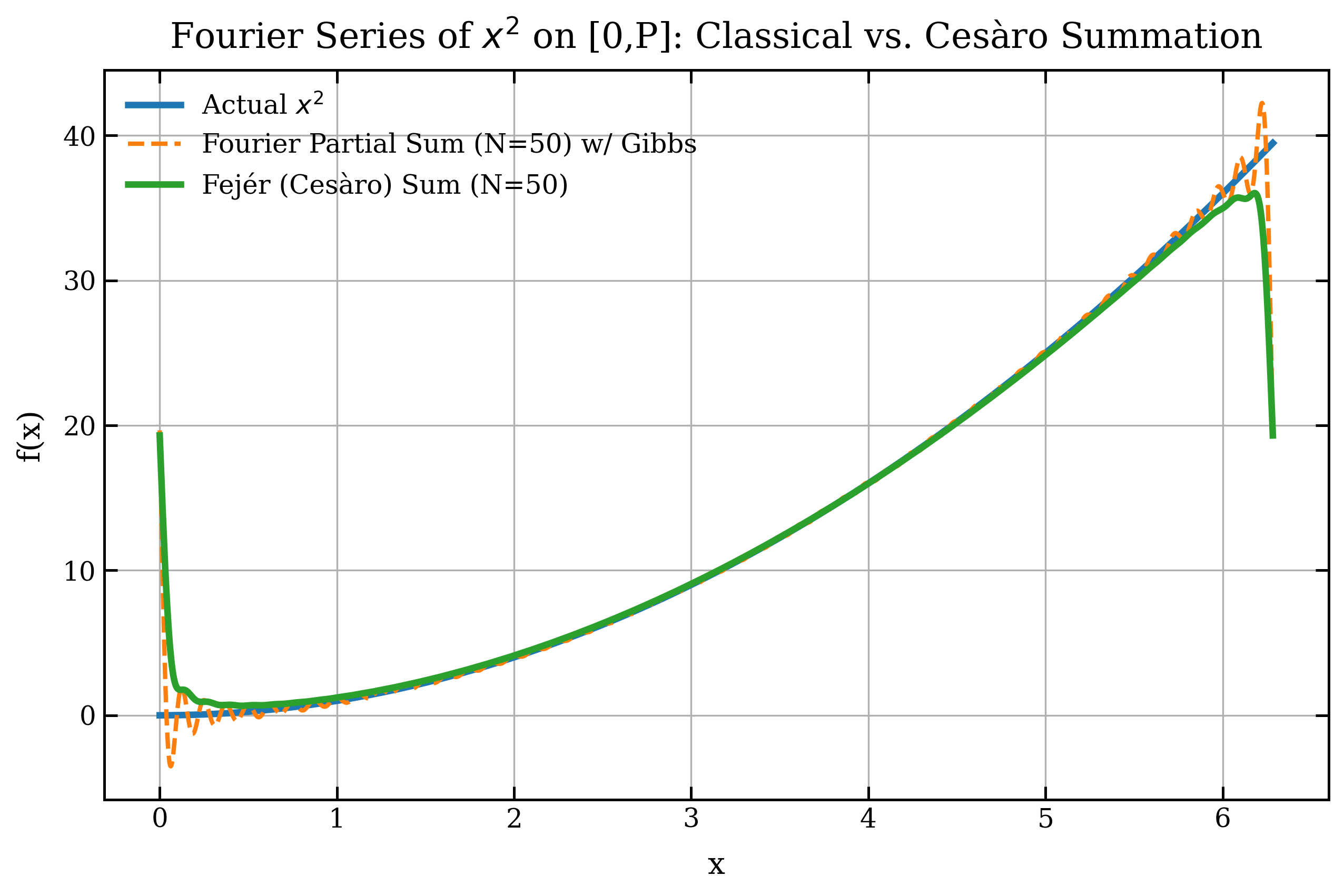
Key Features
- Fourier coefficient computation using trapezoidal rule
- Classical partial sum construction
- Cesàro summation for reduced oscillations
- Comparison of convergence behavior
C++ Implementation
The following C++ code implements Fourier coefficient calculation with a functor-based design:
#include <functional>
#include <vector>
#include <numbers>
#include <cmath>
#include <iostream>

// Helper function: linspace
std::vector<double> linspace(double start, double end, size_t num) {
    std::vector<double> result(num);
    double dx = (end - start) / (num - 1);
    for (size_t i = 0; i < num; ++i) {
        result[i] = start + i * dx;
    }
    return result;
}

// Fourier basis functions
namespace sp {
    struct fourierSine {
        int n;
        double P;
        fourierSine(int n_, double P_) : n(n_), P(P_) {}
        double operator()(double x) {
            double pi = std::numbers::pi_v<double>;
            return std::sin(2.0*n * pi * x / P);
        }
    };

    struct fourierCosine {
        int n;
        double P;
        fourierCosine(int n_, double P_) : n(n_), P(P_) {}
        double operator()(double x) {
            double pi = std::numbers::pi_v<double>;
            return std::cos(2.0*n * pi * x / P);
        }
    };
}

// Trapezoidal rule template
template<typename F>
double trap(F f, double a, double b, int N) {
    double h = (b - a) / N;
    double s = 0.5 * (f(a) + f(b));
    for (int i = 1; i < N; ++i)
        s += f(a + i*h);
    return s * h;
}

// Inner product of two functions
double innerProduct(std::function<double(double)> f,
                    std::function<double(double)> g,
                    double a, double b, int N) {
    auto integrand = [&f, &g](double x) {
        return f(x) * g(x);
    };
    return trap(integrand, a, b, N);
}

// Fourier coefficient calculations
double a0Fourier(std::function<double(double)> f, double P, int n, int N) {
    return 2.0/P * trap(f, 0.0, P, N);
}

double aFourier(std::function<double(double)> f, double P, int n, int N) {
    auto cos_wrapper = sp::fourierCosine(n, P);
    return 2.0/P * innerProduct(f, cos_wrapper, 0.0, P, N);
}

double bFourier(std::function<double(double)> f, double P, int n, int N) {
    auto sin_wrapper = sp::fourierSine(n, P);
    return 2.0/P * innerProduct(f, sin_wrapper, 0.0, P, N);
}

// Fourier interpolant class
struct fourierInterp {
    std::vector<double> an;
    std::vector<double> bn;
    double a0;
    double L;

    fourierInterp(std::vector<double> an_,
                  std::vector<double> bn_,
                  double a0_,
                  double L_)
        : an(an_), bn(bn_), a0(a0_), L(L_) {}

    double operator()(double x) {
        double result = a0 / 2.0;
        double pi = std::numbers::pi_v<double>;

        for (int i = 0; i < an.size(); i++) {
            int n = i + 1;
            result += an[i]*std::cos(2.0*n * pi * x / L)
                    + bn[i]*std::sin(2.0*n * pi * x / L);
        }
        return result;
    }
};

// Example usage
int main() {
    // Define function to approximate: f(x) = x^2
    auto f = [](double x){ return x*x; };

    double L = 6.28;  // Period
    int num_coeffs = 20;
    int integration_points = 20000;

    // Compute coefficients
    double a0 = a0Fourier(f, L, 1, integration_points);
    std::vector<double> a(num_coeffs);
    std::vector<double> b(num_coeffs);

    for(int n = 0; n < num_coeffs; n++) {
        a[n] = aFourier(f, L, n+1, integration_points);
        b[n] = bFourier(f, L, n+1, integration_points);
    }

    // Create interpolant
    fourierInterp finterp(a, b, a0, L);

    // Evaluate on grid
    std::vector<double> xs = linspace(0, L, 1000);
    std::vector<double> ys(xs.size());
    for(int i = 0; i < xs.size(); i++) {
        ys[i] = finterp(xs[i]);
    }

    // Print some results
    std::cout << "a0 = " << a0 << std::endl;
    std::cout << "First few coefficients:" << std::endl;
    for(int i = 0; i < 5; i++) {
        std::cout << "a[" << i+1 << "] = " << a[i]
                  << ", b[" << i+1 << "] = " << b[i] << std::endl;
    }

    return 0;
}