“Know how to solve every problem that has been solved.”“What I cannot create, I do not understand.”— Richard Feynman
Positronium: Para, Ortho, and the Zeeman Effect
Quantum Physics
⛓
What you need to know first
6 concepts, 3 layers
The requisite-knowledge inventory for this page, bottom-up: the
primitives at the base, combined upward until you reach what this page
assumes. Skim the layers you already own; start wherever the ground gets unfamiliar.
1 of these are concepts without a dedicated page yet —
the grey chips. Following the linked ones first makes the rest land.
Take hydrogen, throw away the proton, and put the electron's antiparticle
in its place. The result — positronium — is a real atom with real
spectroscopy and one unusual property: it is made of matter and
antimatter, so every state carries an expiration date. Which date depends
on how the two spins are pointing, and a magnetic field can quietly swap
the labels. That swap, read out through lifetimes, is how the atom's
finest energy interval was measured before anyone could see its light.
Five ways in; read the one that lands.
read it as
Positronium is hydrogen with the proton replaced by a positron. The
Coulomb problem is identical; only the reduced mass changes, from
μ≈me to exactly μ=me/2
(two equal partners). Every hydrogen energy is therefore halved and
every length doubled: binding energy
6.803eV instead of 13.606, mean
electron–positron separation 2a0=1.058 Å, and a
Lyman-α analog at 5.102 eV (2430 Å, in the UV). One knob —
the reduced mass — regenerates the whole spectrum.
The difference is that this atom annihilates. The electron and
positron overlap at the origin (∣ψ(0)∣2=0 for
S states), and where matter meets antimatter with nonzero density,
photons come out. The ground state of positronium is not a stable
floor; it is a starting line.
Two spin-21 particles couple to total spin 0
or 1: a singlet — para-positronium — and a triplet —
ortho-positronium. Charge conjugation sorts their
deaths. A state with quantum numbers L,S has C-parity
(−1)L+S, and a system of n photons has
(−1)n. So the ground-state singlet
(C=+1) must decay to an even number of photons
— two — while the triplet (C=−1) is forced to three.
Three photons cost an extra factor of α and a
three-body phase space, and the price is enormous:
a factor of 1114 at leading order (measured: 125.14 ps and 142.05 ns
— Ore & Powell's three-photon rate, 1949). Same atom, same
orbital, three decades of lifetime apart, decided entirely by spin.
Everything else on this page exploits that gap.
Para and ortho are not degenerate. The spin–spin interaction splits
them — and positronium adds a contribution no ordinary atom has: the
pair can annihilate into a virtual photon and reform, a
process available only to the C=−1 triplet. At leading
order,
That is 204.39 GHz computed, 203.3887 GHz measured — leading order
lands within 0.49%, and the remainder is the
O(α3) QED corrections that make positronium a
precision test bench: a bound state built from two point leptons,
with no nuclear structure to smear the comparison. Note the
proportions: 43% of the splitting comes from the annihilation
channel. Nearly half of this "hyperfine" interval exists because the
atom can momentarily stop existing.
Here is the odd part. In hydrogen, a magnetic field shifts levels —
the ordinary Zeeman fan. In ground-state positronium the first-order
shifts cancel: the positron's magnetic moment is equal and
opposite to the electron's, so the total moment of any definite-spin
state is zero. What survives is the operator
μBBg(σze−−σze+)/2,
which is antisymmetric under exchanging the two spins — and
an antisymmetric operator has no diagonal elements in states of
definite exchange symmetry. Its only nonzero matrix element in the
ground state connects ∣1,0⟩ to
∣0,0⟩.
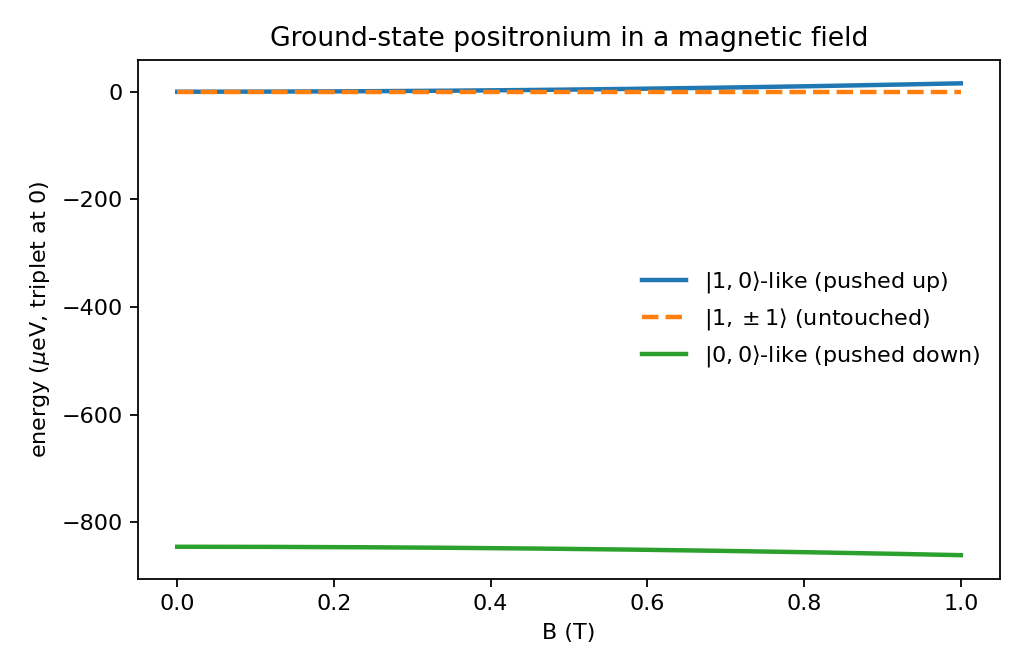
So the field does not shift positronium's levels; it mixes its
identities. The problem collapses to a
two-level system:
singlet and triplet m=0 states separated by the hyperfine
gap, coupled by x=gμBB, while
∣1,±1⟩ — with no m=0 partner to
talk to — sail through untouched.
You cannot see the 203 GHz transition directly with 1951 technology.
But you do not need to: the singlet and triplet die
differently, so any admixture of para character into an ortho
state shows up as a shortened lifetime and a shifted photon budget
(2γ events where 3γ belonged). The lifetime is a meter that reads
out the wavefunction's composition.
That is how it was actually done. Deutsch discovered positronium
(1951), and Deutsch & Brown (1952) applied a magnetic field,
watched the m=0 triplet quench, and fit the curve —
extracting the hyperfine interval from lifetimes years before direct
microwave spectroscopy could touch it. The same logic runs today in
reverse: in materials, the environment steals lifetime from
ortho-positronium, and reading the stolen amount measures the size
of the holes the atom sits in.
The 2×2 that measured a hyperfine interval
In the basis (∣1,0⟩,∣0,0⟩) — triplet at zero,
singlet at −ΔEhfs — the ground-state
Hamiltonian in a field B is
Smallest case by hand: at y≪1 the triplet-like state
rises by ΔEy2/4 and acquires a para amplitude
cpara≈y/2 — second-order shift,
first-order mixing. At 1 T, y=0.274: small enough that the
energies barely move, large enough that
cpara2=1.8% — and 1.8% of a lifetime ratio
of 1114 is not a small effect. The script diagonalizes numerically,
checks the closed form, and checks perturbation theory:
# basis (|1,0>, |0,0>): triplet at 0, singlet at -dE_hfs.# The field's only matrix element in the ground state is BETWEEN them.def two_by_two(B): x = g * muB * B # g = 2.00232 H = np.array([[0.0, x ], [ x , -DE]]) return np.linalg.eigh(H)def tau_mixed(B, tau_ortho): # quenching: the mixed state's lifetime s2 = para_admixture(B) # |<0,0|psi>|^2 from the eigenvector return 1.0 / ((1 - s2)/tau_ortho + s2/TAU_P)
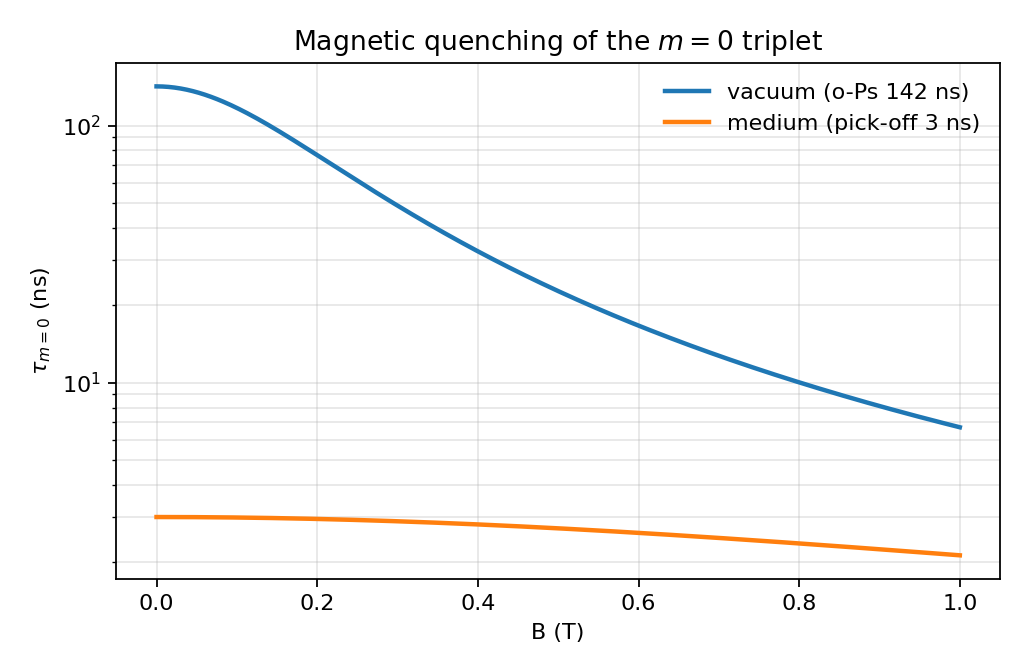
B = 1 T: y = 2 g muB B / dE = 0.2742 numeric eigenvalues: 15.6041, -860.8793 micro-eV closed form: 15.6041, -860.8793 micro-eVB = 0.1 T: numeric para admixture = 1.879e-04, PT (x/dE)^2 = 1.880e-04magnetic quenching of the m=0 triplet (vacuum): B (T) para fraction tau_m0 0.00 0.00e+00 142.05 ns 0.10 1.88e-04 117.10 ns 0.25 1.17e-03 61.02 ns 0.50 4.64e-03 22.70 ns 1.00 1.78e-02 6.70 ns(m = +-1 states: no m=0 singlet partner to mix with -> untouched)
Read the table like Deutsch & Brown did: at 1 T the
m=0 triplet's lifetime has collapsed from 142 ns to
6.7 ns — a factor of 21 — while ∣1,±1⟩ still
lives its full 142 ns. Two thirds of the ortho population is immune and
one third quenches, and the quenching curve's shape depends on exactly
one unknown, ΔEhfs (it enters through
y). Fit the curve, read the gap. A lifetime measurement in
nanoseconds resolved an interval of 0.84 milli-electron-volts.
In media: pick-off gets there first
Put positronium inside matter and the vacuum story acquires a
competitor. Ortho-positronium wandering through a molecular solid
overlaps electrons that are not its own; if one of them has the opposite
spin, the positron annihilates with it — two photons, no
C-parity objection, because the partner electron is not part of the
atom. This pick-off annihilation shortens the o-Ps
lifetime from 142 ns to a few ns in typical polymers and liquids. (A
second channel, spin conversion on paramagnetic species like
O2, flips ortho to para outright — the reason positron
experiments care about dissolved oxygen.)
Now rerun the Zeeman experiment inside the material. The mixing physics
is unchanged — same y, same eigenvectors — but the para
admixture must now compete with a baseline decay that is already fast:
baseline o-Ps lifetime in the medium (pick-off): 3.0 ns
  B (T)   tau_m0 vacuum   tau_m0 medium   vacuum drop   medium drop
  0.10       117.10 ns         2.99 ns        1.2x       1.00x
  0.25        61.02 ns         2.92 ns        2.3x       1.03x
  0.50        22.70 ns         2.71 ns        6.3x       1.11x
  1.00         6.70 ns         2.13 ns       21.2x       1.41x
The same 1 T that quenches the vacuum atom by 21× moves the in-medium
lifetime by only 1.4×. The medium has already spent most of the lifetime
budget through pick-off, so the magnetic meter reads almost flat — a
real experimental design constraint: magnetic-quenching measurements of
positronium's structure want dilute gases, not solids, precisely so that
the field is the only thief.
The flip side is that the theft itself is informative. The pick-off rate
depends on how much the o-Ps wavefunction overlaps the surrounding
electrons — which depends on the size of the cavity it is trapped in.
The Tao–Eldrup model makes this quantitative: a particle in a spherical
well of radius R whose outermost shell of thickness
ΔR=1.66 Å annihilates at the spin-averaged rate
2ns−1:
λpickoff=2ns−1[1−R+ΔRR+2π1sin(R+ΔR2πR)].
Tao-Eldrup: pick-off lifetime -> free-volume pore radius (dR = 1.66 A)
  R = 2.0 A  ->  tau_pickoff = 1.23 ns
  R = 3.0 A  ->  tau_pickoff = 2.16 ns
  R = 4.0 A  ->  tau_pickoff = 3.57 ns
  R = 5.0 A  ->  tau_pickoff = 5.55 ns
Measure a 2.16 ns o-Ps component in your polymer and you have measured
3 Å holes. This is positron annihilation lifetime spectroscopy (PALS),
and it is a working industrial probe of free volume in polymers,
membranes, and porous glasses — the atom that cannot stop dying, hired
as a ruler for cavities nothing else fits inside.
Try First
Each prompt asks a checkable question about the working code or math
above — predict an output, derive a sign, state an invariant, find a
bug. Commit to an answer before clicking "reveal." That commitment is
the whole point: if your answer matched, you understand the piece you
were looking at; if it didn't, that's the part worth re-reading.
why does this work
The field leaves ∣1,±1⟩ strictly alone — no
shift, no mixing, at this order. Give both reasons (one about
operators, one about available partners).
answer
The Zeeman operator here is proportional to
σze−−σze+. Acting on
∣↑↑⟩ it gives zero outright (the
two terms cancel on aligned spins), so there is no diagonal shift.
And mixing requires a state with the same m to mix
into: the only m=±1 state in the ground
manifold is the triplet itself — the singlet has
m=0 only. No partner, no mixing. Both protections
break for excited states or once the field couples orbital motion.
predict
A detector counts 2γ and 3γ annihilation events from a thermal
positronium population in vacuum as B ramps from 0 to 1 T.
Predict what happens to the 3γ/2γ ratio, and which fraction of events
saturates it.
answer
The 3γ fraction falls. At B=0, all ortho atoms
(3/4 of the population) decay 3γ. As B grows, the
m=0 third of them acquires para character and
increasingly dies 2γ — at 1 T its branching is already dominated by
the para channel (1.8% admixture × 1114 lifetime ratio ≈ 20:1 for
2γ). But ∣1,±1⟩ never quenches, so the 3γ
signal saturates near 2/3 of its zero-field value instead of
vanishing. That surviving plateau is the experimental fingerprint
that only one of the three triplet states feels the field.
what if
Your PALS spectrometer reports an o-Ps lifetime of 3.57 ns in an
unknown porous material. What pore radius does Tao–Eldrup assign, and
what does the model quietly assume that could bias it?
answer
From the table, 3.57 ns ↔ R=4.0 Å. The model assumes
spherical cavities, a universal electron-layer thickness
ΔR=1.66 Å calibrated on molecular solids, and
o-Ps fully thermalized in its lowest cavity state. Elongated pores,
interconnected free volume, or chemistry that quenches Ps (strong
oxidizers, paramagnetic centers) all violate the assumptions — the
radius is model-defined, which is why PALS papers report "Tao–Eldrup
radius" rather than pretending to a model-free length.
Where this goes
The two-state mixing machinery here is the same one behind every avoided
crossing on the site — the
two-level system is the
reusable part, and positronium is its cleanest atomic incarnation
because the diagonal shifts cancel exactly. The spin-statistics
bookkeeping (singlet/triplet, exchange symmetry) is the same
accounting that splits singlet
and triplet excitations in molecules. And the validation script —
every number above, from the 204.39 GHz leading-order interval to the
2.16 ns Tao–Eldrup lifetime — is
scripts/gen_positronium.py in the repo.