2D Finite Difference Method
Numerical Methods
The finite difference method is a numerical technique for solving partial differential equations (PDEs) by discretizing the domain and approximating derivatives using finite differences. This page demonstrates solving the 2D Laplace equation using the Gauss-Seidel iterative method.
2D Laplace Equation
The Laplace equation in two dimensions is:
This equation appears in many physical contexts, including:
- Electrostatics (electric potential)
- Heat conduction (steady-state temperature)
- Fluid flow (stream function)
- Gravitational potential
Finite Difference Discretization
Using central differences on a uniform grid with spacing , the second derivatives are approximated as:
Substituting into the Laplace equation and rearranging gives:
This is the discrete form of the Laplace equation: each interior point is the average of its four nearest neighbors.
Gauss-Seidel Iteration
The Gauss-Seidel method solves the system iteratively by updating each point using the most recent values:
The iteration continues until convergence, typically measured by:
where is a small tolerance.
Boundary Conditions
Boundary conditions must be specified. Common types include:
- Dirichlet: on the boundary
- Neumann: on the boundary
- Mixed: Different conditions on different parts of the boundary
Python Implementation
The following code solves the 2D Laplace equation with various boundary conditions:
import numpy as np
import matplotlib.pyplot as plt
import matplotlib as mpl

def set_publication_style():
    """Set publication-quality matplotlib style."""
    mpl.rcParams.update({
        'font.family': 'serif',
        'font.size': 12,
        'axes.labelsize': 14,
        'axes.titlesize': 16,
        'axes.linewidth': 1.2,
        'axes.labelpad': 8,
        'axes.titlepad': 10,
        'xtick.labelsize': 12,
        'ytick.labelsize': 12,
        'xtick.direction': 'in',
        'ytick.direction': 'in',
        'xtick.top': True,
        'ytick.right': True,
        'xtick.major.size': 6,
        'ytick.major.size': 6,
        'xtick.major.width': 1.2,
        'ytick.major.width': 1.2,
        'legend.fontsize': 12,
        'legend.frameon': False,
        'lines.linewidth': 2,
        'lines.markersize': 6,
        'figure.dpi': 100,
        'savefig.dpi': 300,
        'savefig.bbox': 'tight'
    })

set_publication_style()

def solve_laplace_2d(Lx, Ly, Nx, Ny, boundary_conditions, tolerance=1e-6, max_iter=10000):
    """
    Solve the 2D Laplace equation using Gauss-Seidel iteration.

    Parameters:
        Lx, Ly: Domain dimensions
        Nx, Ny: Number of grid points
        boundary_conditions: Function that sets boundary values
        tolerance: Convergence tolerance
        max_iter: Maximum iterations

    Returns:
        u: Solution array
        iterations: Number of iterations
    """
    # Initialize solution array
    u = np.zeros((Nx, Ny))

    # Set boundary conditions
    boundary_conditions(u, Lx, Ly, Nx, Ny)

    # Gauss-Seidel iteration
    for iteration in range(max_iter):
        u_old = u.copy()

        # Update interior points
        for i in range(1, Nx-1):
            for j in range(1, Ny-1):
                u[i, j] = 0.25 * (u[i+1, j] + u[i-1, j] + u[i, j+1] + u[i, j-1])

        # Reapply boundary conditions (in case they depend on iteration)
        boundary_conditions(u, Lx, Ly, Nx, Ny)

        # Check convergence
        if np.max(np.abs(u - u_old)) < tolerance:
            return u, iteration + 1

    return u, max_iter

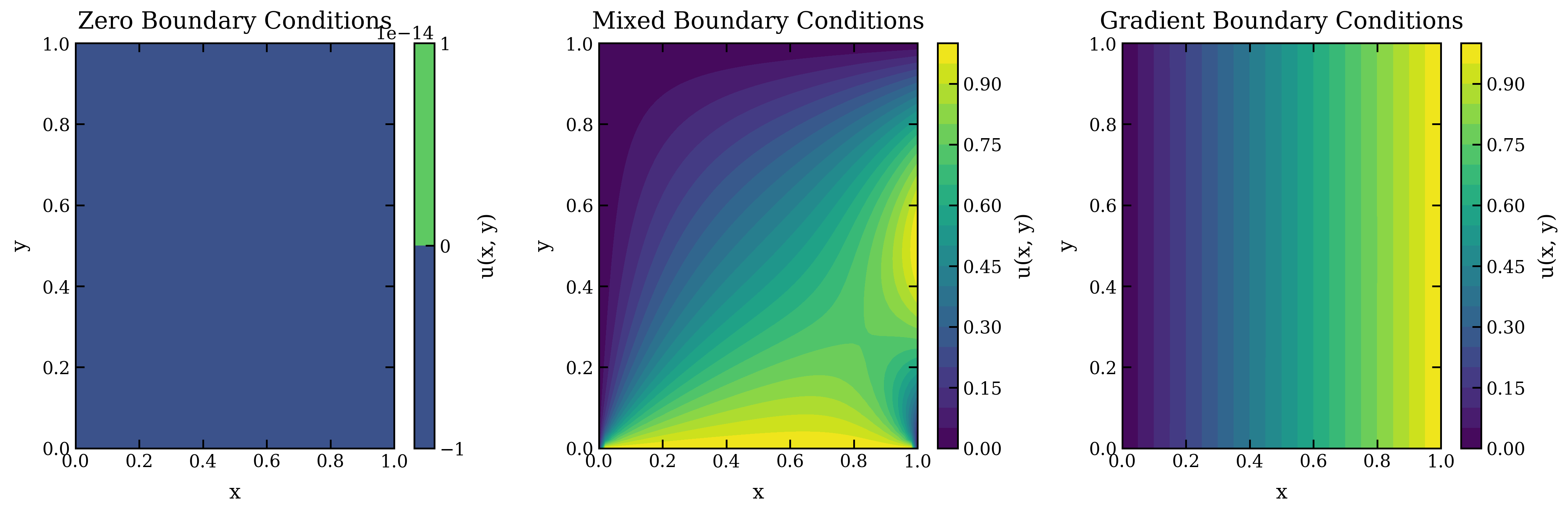
# Example 1: Zero boundary conditions
def zero_boundary(u, Lx, Ly, Nx, Ny):
    """All boundaries set to zero."""
    u[:, 0] = 0    # Left
    u[:, -1] = 0   # Right
    u[0, :] = 0    # Bottom
    u[-1, :] = 0   # Top

# Example 2: Mixed boundary conditions
def mixed_boundary(u, Lx, Ly, Nx, Ny):
    """Mixed boundary conditions."""
    u[:, 0] = 1.0                                    # Left: u = 1
    u[:, -1] = 0.0                                   # Right: u = 0
    u[0, :] = 0.0                                    # Bottom: u = 0
    x = np.linspace(0, Lx, Nx)
    u[-1, :] = np.sin(np.pi * x / Lx)                # Top: u = sin(πx/Lx)

# Example 3: Linear gradient
def gradient_boundary(u, Lx, Ly, Nx, Ny):
    """Linear gradient from left to right."""
    y = np.linspace(0, Ly, Ny)
    u[:, 0] = y / Ly                                 # Left: linear gradient
    u[:, -1] = y / Ly                                # Right: same gradient
    u[0, :] = 0.0                                    # Bottom: u = 0
    u[-1, :] = 1.0                                   # Top: u = 1

# Parameters
Lx, Ly = 1.0, 1.0
Nx, Ny = 50, 50

# Solve Example 1: Zero boundaries
print("Example 1: Zero boundary conditions")
u1, iter1 = solve_laplace_2d(Lx, Ly, Nx, Ny, zero_boundary)
print(f"Converged in {iter1} iterations")

# Solve Example 2: Mixed boundaries
print("\nExample 2: Mixed boundary conditions")
u2, iter2 = solve_laplace_2d(Lx, Ly, Nx, Ny, mixed_boundary)
print(f"Converged in {iter2} iterations")

# Solve Example 3: Gradient boundaries
print("\nExample 3: Gradient boundary conditions")
u3, iter3 = solve_laplace_2d(Lx, Ly, Nx, Ny, gradient_boundary)
print(f"Converged in {iter3} iterations")

# Plotting
fig, axes = plt.subplots(1, 3, figsize=(15, 5))

X, Y = np.meshgrid(np.linspace(0, Lx, Nx), np.linspace(0, Ly, Ny))

# Example 1
im1 = axes[0].contourf(X, Y, u1.T, 20, cmap='viridis')
axes[0].set_title('Zero Boundary Conditions')
axes[0].set_xlabel('x')
axes[0].set_ylabel('y')
plt.colorbar(im1, ax=axes[0], label='u(x, y)')

# Example 2
im2 = axes[1].contourf(X, Y, u2.T, 20, cmap='viridis')
axes[1].set_title('Mixed Boundary Conditions')
axes[1].set_xlabel('x')
axes[1].set_ylabel('y')
plt.colorbar(im2, ax=axes[1], label='u(x, y)')

# Example 3
im3 = axes[2].contourf(X, Y, u3.T, 20, cmap='viridis')
axes[2].set_title('Gradient Boundary Conditions')
axes[2].set_xlabel('x')
axes[2].set_ylabel('y')
plt.colorbar(im3, ax=axes[2], label='u(x, y)')

plt.tight_layout()
plt.savefig('figures/laplace_2d_solutions.png', dpi=300, bbox_inches='tight')
plt.show()
Visualization
The following plot shows solutions to the 2D Laplace equation with different boundary conditions:
Convergence Properties
The Gauss-Seidel method converges for the Laplace equation because:
- The discrete Laplacian matrix is diagonally dominant
- The spectral radius of the iteration matrix is less than 1
- The method is stable for well-posed boundary value problems
The convergence rate depends on:
- Grid spacing (finer grids converge slower)
- Boundary conditions (smooth boundaries converge faster)
- Initial guess (closer guesses require fewer iterations)
Applications
The 2D finite difference method for Laplace's equation is widely used in:
- Electrostatics: Computing electric potential from charge distributions
- Heat transfer: Steady-state temperature distributions
- Fluid mechanics: Potential flow and stream functions
- Image processing: Smoothing and denoising
- Computer graphics: Surface fairing and mesh smoothing
Extensions
The method can be extended to:
- Poisson equation: with source term
- 3D problems: Using 6-point stencil instead of 4-point
- Non-uniform grids: Adaptive mesh refinement
- Non-linear equations: Iterative linearization